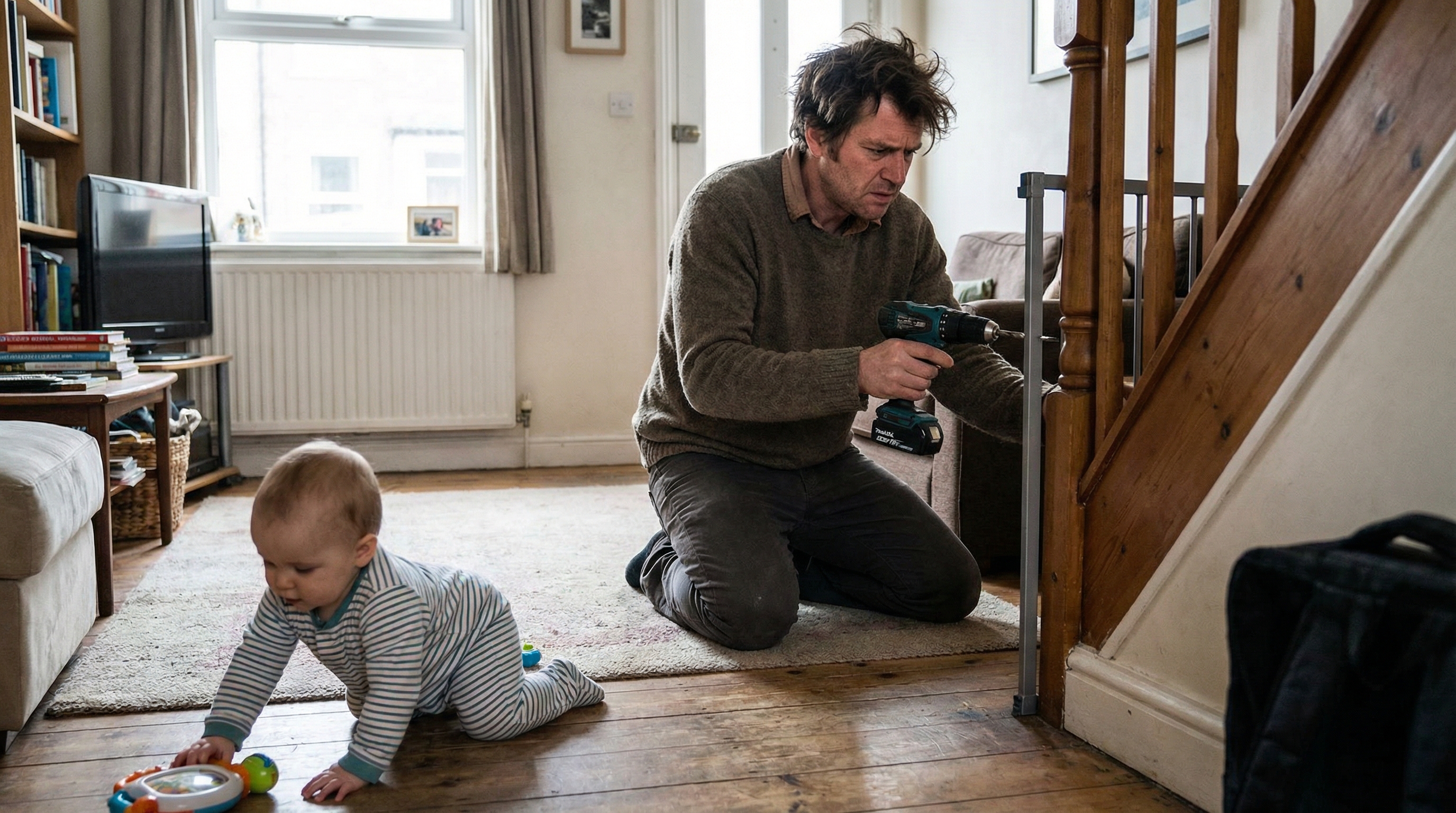


It's 2am. Your six-month-old just figured out how to roll across the living room floor. And you're suddenly aware that the power strip behind the sofa is completely exposed, the bookshelf isn't anchored to the wall, and there's a marble-sized battery sitting on the coffee table.
Most parents baby-proof too late. They wait until their child is already crawling - or worse, until they've already had a scare. Others go nuclear too early, spending hundreds of pounds turning the house into a padded cell before the baby can even lift their own head.
The truth is somewhere in the middle. Baby proofing isn't a one-time event - it's a rolling process that should match your child's development. Each stage brings new abilities, and new abilities bring new risks.
This guide breaks it down by age, so you know exactly what to do and when to do it. No panic, no guesswork, no trip to A&E.
Before We Start: The Mindset Shift
Baby proofing isn't about wrapping your child in cotton wool. It's about removing the genuinely dangerous stuff so your baby can explore freely. There's an important difference between a bump on the head (part of learning) and a furniture tip-over (potentially fatal).
Your job isn't to eliminate every risk. It's to eliminate the catastrophic ones and manage the rest.
Get down on your hands and knees - literally - and see the world from your baby's height. You'll spot dangers you'd never notice standing up. That dangling tablecloth. That exposed cable. That tiny Lego piece your toddler nephew left behind.
0–3 Months: Safe Sleep and SIDS Prevention
Your newborn isn't mobile yet, but that doesn't mean there's nothing to do. This stage is almost entirely about safe sleep - because SIDS (Sudden Infant Death Syndrome) is the biggest risk in the first few months.
Your Checklist
- Firm, flat mattress - no memory foam, no pillows, no sleep positioners. The Lullaby Trust recommends a firm, flat, waterproof mattress that fits the cot with no gaps
- Clear the cot - nothing in there except a fitted sheet. No bumpers, no teddies, no blankets (use a sleeping bag instead)
- Room temperature - keep the room between 16–20°C. Get a room thermometer if you haven't already
- Back to sleep - always place baby on their back. Every single time
- No smoking anywhere in the house - this is a massive SIDS risk factor that doesn't get enough attention
- Co-sleeping safety - if you're bed-sharing (and many parents do, even if they didn't plan to), know the safe co-sleeping guidelines from the Lullaby Trust. Never co-sleep on a sofa or armchair - this is the single most dangerous sleeping arrangement
- Blind cords - tie up or cut any looped blind cords in the nursery. These are a strangulation hazard even for newborns in cots placed near windows
- Smoke and carbon monoxide detectors - test them. Replace batteries. Do it now
What You Can Skip for Now
Socket covers, stair gates, cupboard locks - you don't need any of this yet. Save your energy (and money) for the months ahead.
4–6 Months: The Rolling Stage
One day your baby is lying on their play mat, perfectly still. The next day they've rolled three feet to the left and are trying to eat a shoe. For a full picture of what's coming developmentally, see our baby milestones month by month guide. This transition happens fast, and it catches a lot of parents off guard.
Your Checklist
- Never leave baby unattended on raised surfaces - changing tables, sofas, beds. It only takes one roll. This is the number one cause of infant falls in the UK
- Floor-level play - start defaulting to the floor for playtime. A thick play mat on carpet is ideal
- Check for small objects at floor level - get a toilet roll tube: if something fits through it, it's a choking hazard
- Secure the changing area - always keep one hand on baby during nappy changes. Better yet, change them on the floor
- Start looking at your room layout - your baby will be crawling within weeks. Now's the time to plan, not react
- Remove low-hanging tablecloths - once they can grab, they'll pull everything on top of themselves, including hot drinks
What You Can Start Buying
Stair gates (pressure-fit for most doorways, screw-fit for the top of stairs - always screw-fit at the top), socket covers, and corner protectors. You'll need them soon.
6–9 Months: Crawling - This Is the Big One
Crawling changes everything. Your baby now has access to the entire floor level of your home. They're fast, they're curious, and they put absolutely everything in their mouth.
This is where most of your baby proofing investment happens.
Your Checklist
- Stair gates - fit gates at the top AND bottom of every staircase. Top-of-stairs gates must be screw-fitted to the wall, not pressure-mounted. Check they meet BS EN 1930:2011 (the British safety standard)
- Socket covers - cover every unused socket at baby height. In the UK, the debate continues about whether socket covers are necessary given the built-in shutters on BS 1363 sockets. The reality: some covers can actually be pushed in a way that defeats the shutter mechanism. If in doubt, use blank socket plates (a blank faceplate that replaces the socket entirely) rather than plastic inserts
- Floor sweep - daily. Get obsessive about it. Coins, batteries, small toys, hair clips, pen lids - all choking hazards
- Cupboard and drawer locks - especially in the kitchen and bathroom. Lock anything containing cleaning products, medicines, sharp objects, or plastic bags
- Toilet lock - drowning can happen in just a few centimetres of water. A toilet lock costs about £5
- Furniture anchoring - this is critical. Anchor all bookcases, chests of drawers, wardrobes, and TV units to the wall using anti-tip straps. Furniture tip-overs kill children every year. IKEA provides free wall-anchoring kits for their furniture - use them
- Cable management - tidy up trailing cables behind the TV, computer desk, and lamps. Use cable tidies or run them behind furniture. Babies pull cables and bring heavy objects down on themselves
- Houseplant check - several common houseplants are toxic if eaten. Move them out of reach or remove them. Check the RHS or Childline plant safety list
- Radiator covers - if your radiators get hot to the touch, fit covers or turn down the thermostat on individual radiators in baby-accessible rooms
- Door slam guards - foam door stoppers prevent pinched fingers. A slammed door can break a small finger
Kitchen-Specific
- Turn pan handles inward on the hob
- Use the back burners when possible
- Keep kettles and their cables well back from the counter edge
- Lock the dishwasher - the tablets are brightly coloured and look like sweets
- Keep the bin locked or behind a cupboard door
Bathroom-Specific
- Never leave a baby alone in the bath - not even for a second
- Non-slip mat in the bath
- Keep all medicines, razors, and toiletries in a locked cabinet
- Check your hot water temperature - it should be no higher than 48°C at the tap
9–12 Months: Pulling Up and Cruising
Your baby is now hauling themselves up on everything - furniture, your legs, the dog. They're exploring vertically, which means a whole new set of risks.
Your Checklist
- Re-check furniture anchoring - pulling-up babies put lateral force on furniture. If it wobbles at all, anchor it
- TV safety - if your TV is on a stand (not wall-mounted), it's a tip-over risk. Wall-mounting is the safest option. Flatscreen TVs are deceptively heavy and top-heavy
- Window restrictors - fit restrictors on all windows that a child could reach. In England, window restrictors are legally required in rental properties with children under 10 (Housing Health and Safety Rating System). They should limit the opening to 6.5cm or less
- Remove freestanding floor lamps - a pulling baby will bring them down
- Fireplace guards - if you have an open fire or wood burner, fit a fixed fireguard that attaches to the wall. Freestanding guards can be pulled over
- Table corners - fit corner protectors on coffee tables and any sharp-edged furniture at baby head height. The cheap foam ones work perfectly fine
- Check toy boxes - lids should have slow-close hinges or no lid at all. Slamming toy box lids trap fingers and can cause head injuries
- Pet bowls - move them to a room with a baby gate or to a raised feeding station. Pet water is a drowning risk, and pet food is a choking risk
Want the complete guide?
Everything from pregnancy to age two. Evidence-based, dad-tested, no fluff.
Get The New Dad Playbook - £2912–18 Months: Walking, Climbing, Getting Into Everything
Welcome to the toddler era. Your child can now walk, climb, open drawers, turn handles, and operate the TV remote better than you can. They're relentless, creative, and seemingly fearless.
Your Checklist
- Door handle covers or locks - prevent access to rooms that aren't baby-proofed (garage, utility room, home office)
- Fridge and oven locks - toddlers can open both. An oven door is a climbing frame and a burn risk
- Climbing assessment - look at everything as a ladder. Dining chairs pushed against counters. Drawer units used as steps. Storage cubes next to the cot. Move or secure anything that creates a climbing route to a dangerous height
- Cot mattress at lowest setting - if you haven't done this already, do it now. Once they can pull up, they can go over the rail
- Garden and outdoor hazards - if your child is walking, they'll want to explore outside. Secure garden gates, cover or fence ponds (even small decorative ones), lock sheds and outbuildings, and remove or fence off any poisonous plants. Check for fox mess regularly
- Driveway safety - never let a toddler near a driveway where a car might move. Reversing accidents in driveways are a specific and well-documented risk
- Medicine and cleaning product re-audit - your toddler can now reach higher than you think. Move everything at least 1.5 metres up, or into locked storage. This includes handbag contents (think paracetamol, hand sanitiser, vape liquid)
- Button batteries - the single most dangerous household item for small children. A swallowed button battery can cause fatal internal burns within two hours. Audit every remote control, key fob, musical greeting card, and tea light. Secure battery compartments with tape if the screw cover is loose
- Blind cord update - from 2014, all new blinds sold in the UK must be cordless or have inaccessible cords. If you have older blinds, replace them or retrofit a cord cleat high on the wall
The UK-Specific Stuff You Should Know
A few things that are specifically relevant if you're baby-proofing in the UK:
- Window restrictors in rentals - if you're a private renter, your landlord has a legal obligation under the HHSRS to ensure windows aren't a fall risk. Request restrictors in writing if they're not fitted
- Gas safety - your landlord must provide an annual Gas Safety Certificate. If you own your home, get your boiler serviced annually and fit a carbon monoxide alarm in every room with a gas appliance
- Fireguards - the BS 8423 standard covers fireguards. Make sure any guard you buy meets this standard
- Water temperature - UK building regulations recommend stored hot water at 60°C (to prevent legionella) but delivered at no more than 48°C. Thermostatic mixing valves (TMVs) do this automatically - check if yours are fitted, especially on bath taps
- Second-hand equipment - car seats, cots, and stair gates bought second-hand may not meet current safety standards. If you can't verify the age and history, buy new. Car seats should never be second-hand unless you know for certain they haven't been in an accident
The Printable Checklist
Here's the quick-reference version you can stick on the fridge:
0–3 months: Safe sleep setup, room temperature, smoke alarms, blind cords
4–6 months: No raised surfaces unsupervised, floor-level play, remove small objects
6–9 months: Stair gates, socket covers, cupboard locks, furniture anchoring, cable management, toilet lock
9–12 months: Window restrictors, TV secured, fireplace guard, corner protectors, pet bowls moved
12–18 months: Door and oven locks, climbing routes removed, outdoor hazards, button battery audit, medicine re-audit
Don't Forget to Re-Audit
Baby proofing isn't set-and-forget. Every month or so, get down on your hands and knees again and look for new risks. If you're still in the newborn stage, our guide to what you actually need for a newborn helps you prioritise your setup. Your child's abilities change rapidly, and yesterday's safe room might be tomorrow's hazard zone.
Also - and this catches a lot of parents out - re-audit after visiting other people's houses, after Christmas (new toys with small parts and batteries), and after any furniture rearrangement.
Want the complete safety guide?
The New Dad Playbook covers baby proofing plus everything else - from pregnancy prep to toddler survival. Evidence-based, dad-tested, no fluff.
Get The New Dad Playbook - £29Frequently Asked Questions
When should I start baby proofing?
Start the safe sleep basics from day one. Do your main baby proofing push around 4–5 months - before your baby starts crawling, not after. Most parents leave it too late and end up scrambling to fit stair gates while their baby is already on the move. Getting ahead of each developmental stage is the whole point.
Are socket covers actually necessary in the UK?
This is genuinely debated. UK sockets (BS 1363) have built-in shutters, and some safety experts - including the Fatally Flawed campaign - argue that certain plug-in socket covers can actually defeat these shutters and make sockets less safe. If you want extra protection, consider blank socket plates (which replace the entire faceplate) rather than plastic insert covers.
What's the most dangerous household item for babies?
Button batteries. If a child swallows a lithium button battery, it can burn through the oesophagus within two hours and can be fatal. They're found in remote controls, key fobs, bathroom scales, musical greeting cards, flameless candles, and dozens of other household items. Audit your home, secure every battery compartment, and keep spares locked away.
Do I need to baby-proof if I'm renting?
Yes - and your landlord has legal obligations too. Under the Housing Health and Safety Rating System (HHSRS), landlords must address fall risks including windows without restrictors. You can fit pressure-mounted stair gates, cupboard locks, and corner guards without damaging the property. For screw-fitted gates (essential at the top of stairs), ask your landlord in writing - most will agree, and it's a reasonable request for child safety.
How much does baby proofing cost?
You can do a thorough job for £100–£200 if you prioritise the essentials. Stair gates (£20–£40 each), furniture anchoring straps (£5–£10 for a pack), cupboard locks (£10–£15 for a set), corner protectors (£5–£8), and a toilet lock (£5). Skip the expensive "baby proofing kits" that include things you don't need. Buy what's relevant to your home and your baby's current stage.
Should I hire a professional baby proofer?
Probably not. Professional baby proofing services exist but they're expensive (£200–£500+) and they tend to over-recommend products. You know your home better than anyone. Use this checklist, get down to baby height, and work through it room by room. The only exception might be if you have an unusually complex home (multiple levels, a pool, extensive outdoor space) where a professional assessment adds genuine value.