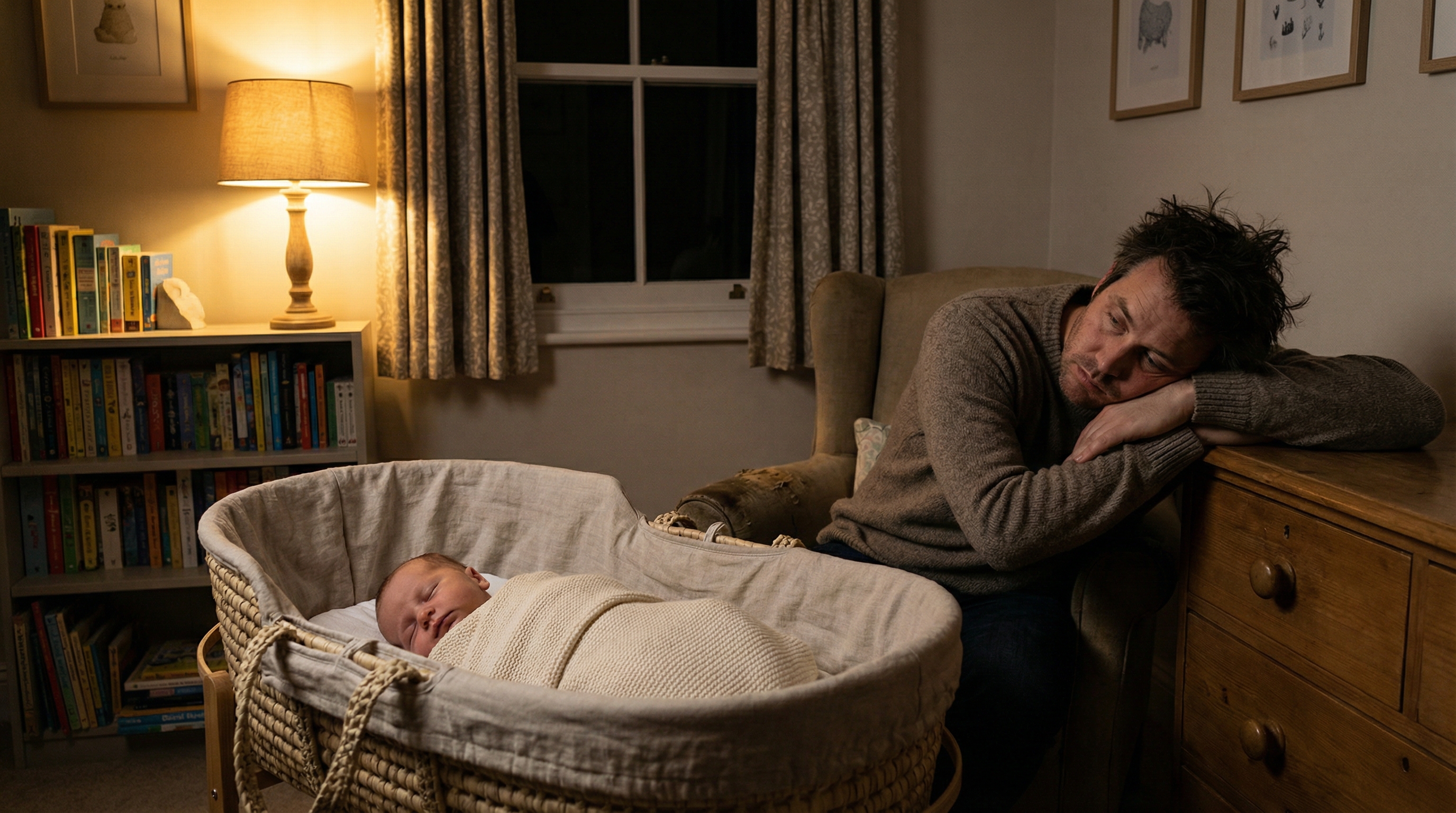


Newborn Sleep in the First 6 Weeks: What to Actually Expect (and How to Survive It)
You're googling "newborn sleep schedule first 6 weeks" at 3am, one eye open, a baby who was asleep four minutes ago now wide awake and furious about it.
Here's the truth no one tells you upfront: there is no newborn sleep schedule for the first 6 weeks. Not one that works. Not one your baby has read and agreed to. The sooner you accept that, the sooner you stop fighting something that isn't broken - it's just biology.
This guide will tell you what's actually normal, what's happening inside your baby's developing brain, and - most importantly - how you and your partner can survive the chaos without losing your minds.
Why There's No Schedule (and That's Normal)
Your newborn doesn't know what time it is. They literally can't tell the difference between day and night. This isn't a failure of parenting - it's basic neuroscience.
Babies aren't born with a functioning circadian rhythm. That internal clock that tells adults when to feel sleepy and when to feel alert? It doesn't even begin developing until around 6–8 weeks, and it won't fully mature until 3–4 months.
In the womb, your baby's sleep-wake cycle was regulated by your partner's melatonin crossing the placenta. Now they're on the outside, their brain has to build that system from scratch.
So when someone asks "what's your baby's routine?" in week two, the honest answer is: they don't have one, and they're not supposed to.
What newborn sleep actually looks like
Here's what the science says about sleep in the first 6 weeks:
- Total sleep: 14–17 hours per 24-hour period (NHS and Lullaby Trust guidelines)
- Longest stretch: Usually 2–4 hours, day or night
- Sleep cycles: Around 40–50 minutes (adults have 90-minute cycles)
- Active sleep: About 50% of their sleep is "active" (REM) - they twitch, grunt, flail, make faces
- Feeding frequency: Every 1.5–3 hours, including overnight
That 14–17 hours sounds brilliant until you realise it's split into chunks so small you never get more than a couple of hours yourself. And because half their sleep is active and noisy, you'll spend a lot of time staring at them thinking "are they awake?" when they're actually asleep.
Dad tip: If your baby is grunting, squirming, or making little noises but their eyes are closed, wait 2–3 minutes before picking them up. They're probably in active sleep and may settle on their own.
Day-Night Confusion: Why Your Baby Parties at 3am
Day-night confusion is the single most frustrating thing about newborn sleep, and almost every baby does it. Your baby slept beautifully during daylight hours and is now wide awake at 2am looking at you like they've just had a double espresso.
This happens because in the womb, your baby was most active when your partner was resting (less movement meant more room to wriggle). That pattern doesn't magically reverse at birth.
How to fix day-night confusion
You can't force it, but you can nudge it. Here's what actually works:
During the day:
- Keep the house bright and don't tiptoe around - normal noise, normal light
- Open curtains even during naps
- Talk to your baby, play with them during awake windows
- Don't let them sleep longer than 3 hours without a feed during the day
At night:
- Keep lights dim - use a warm-toned night light, not the big light
- Keep interactions boring - feed, change, back to bed, minimal chat
- No screens near the baby (the blue light doesn't help)
- Keep your voice low and calm
Most babies start sorting their days from their nights by around 3–4 weeks if you're consistent with these cues. Some take longer. It's not a parenting report card.
Week-by-Week Rough Guide: Weeks 1–6
This isn't a schedule. It's a "what to roughly expect" guide based on developmental norms. Your baby hasn't read this. Expect variation.
Week 1: Survival Mode
Your baby is recovering from being born. They're sleepy - sometimes frustratingly so, because you need them to wake up and feed.
- Sleep: 16–18 hours total, in 1–3 hour bursts
- Awake windows: 30–45 minutes max (including feeding)
- Your job: Feed, burp, change, hold, repeat. That's it.
- What's normal: Baby falling asleep mid-feed. Difficulty latching. You feeling utterly shell-shocked.
Week 2: The Fog
The adrenaline from birth wears off. The tiredness hits. Your baby is slightly more alert but still sleeping most of the day.
- Sleep: 15–17 hours total
- Awake windows: 45 minutes–1 hour
- Watch for: Day-night confusion kicking in properly now
- Your job: Start the day/night cues. Light in the day, dark at night.
Week 3: The Witching Hour Arrives
Welcome to the evening fussy period. Somewhere between 5pm and midnight, your baby will cry. A lot. For no apparent reason. This is textbook normal and peaks around 6 weeks.
- Sleep: 15–17 hours total
- Longest stretch: Some babies start doing one 3–4 hour block (usually during the day, annoyingly)
- Your job: Take over the evening shift so your partner can sleep. This is where dads earn their stripes.
Week 4: You're Getting the Hang of It (Sort Of)
You're starting to read the cues. You can tell the difference between "I'm hungry" and "I'm tired" cries. Maybe. Sometimes.
- Sleep: 14–16 hours total
- Awake windows: 45 minutes–1.5 hours
- Small wins: Day-night confusion may be improving. You might get a slightly longer stretch at night.
- Reality check: "Longer stretch" means 3–4 hours. Lower the bar. Then lower it again.
Week 5: Light at the End of the Tunnel
Your baby's circadian rhythm is starting to develop. You might notice slightly more predictable sleepy times, especially in the evening.
- Sleep: 14–16 hours total
- Awake windows: 1–1.5 hours
- Hopeful sign: Some babies start clustering feeds in the evening and sleeping a longer first stretch at night
- Still normal: Waking every 2 hours. Crying for no reason. You feeling exhausted.
Week 6: Peak Fussiness, But Also Progress
This is often the hardest week - fussiness peaks, but so does your baby's social awareness. You'll get your first real smiles. It changes everything.
- Sleep: 14–16 hours total
- Awake windows: 1–1.5 hours
- The reward: Those first proper smiles. Not wind. Real smiles. At you.
- What's coming: From here, sleep gradually consolidates. It gets better.
Maximising Your Sleep: The Shift System
You can't make your baby sleep longer. But you can be strategic about how you and your partner share the load. The shift system is the single most effective thing you can do.
How shifts work
Split the night into two blocks. One parent is "on duty" for each block. The off-duty parent sleeps - properly sleeps, in a different room if possible, with earplugs in.
Example:
- Partner: Sleeps 8pm–2am (6 hours unbroken)
- You: Sleeps 2am–8am (6 hours unbroken)
- On-duty parent: Handles all feeds, changes, and settling during their shift
If your partner is breastfeeding, they can pump a bottle for your shift, or you handle everything except the feed (bring baby to partner, do the burping and settling, put baby back down).
Six hours of unbroken sleep is a completely different experience to eight hours of broken sleep. It will save your sanity and probably your relationship.
Safe sleep basics every dad should know
The Lullaby Trust guidelines are clear, and this is non-negotiable:
- Back to sleep, every sleep - always on their back
- Clear cot - no pillows, no duvets, no bumpers, no toys, no loose blankets
- Feet to foot - baby's feet at the bottom of the cot
- Room temperature: 16–20°C (invest in a room thermometer)
- Same room as you for the first 6 months, for every sleep (day naps too)
- No co-sleeping on a sofa or armchair - this is the highest risk factor for SIDS
If you're falling asleep holding your baby, it's safer to co-sleep in a properly set-up bed than on a sofa. The Lullaby Trust has guidance on safer co-sleeping if it happens.
When It Gets Better
Here's what you need to hear right now: it gets better, and it's closer than you think.
- 6–8 weeks: Circadian rhythm starts developing. Day-night sorting improves.
- 3–4 months: Many babies consolidate to longer stretches. Some (not all) start sleeping 5–6 hours at a time.
- 4–6 months: Sleep patterns become more predictable. You can start gentle routines.
Notice I didn't say "sleeping through the night" - because the expectation that babies should sleep 12 hours straight by 3 months is a myth. What you're aiming for is longer stretches and more predictability, not perfection.
Things That Don't Work (Save Your Money)
A quick word on the newborn sleep industry, because it preys on desperate, exhausted parents:
- Sleep training before 4 months: Developmentally inappropriate. Don't bother.
- White noise machines: Actually, these DO work for many babies. The exception on this list. Get one.
- "Dream feed" schedules for newborns: Too early. Their stomachs are tiny. Feed on demand.
- Expensive sleep consultants for a 3-week-old: Save your money. What you're experiencing is normal biology.
- Weighted sleep sacks for newborns: Not recommended by the Lullaby Trust. Don't risk it.
What does work? Time. Patience. The shift system. And white noise.
The Dad's Emotional Survival Guide
Nobody talks about how newborn sleep deprivation affects dads specifically. So let's talk about it.
You will feel:
- Useless - especially if your partner is breastfeeding and you can't do the one thing baby wants
- Resentful - of the baby, of your partner, of people who sleep. All normal.
- Scared - you'll check they're breathing. A lot. That's not anxiety, that's being a parent.
- Guilty - for every negative feeling above
This is all normal. Sleep deprivation is literally used as a form of torture. You're not weak for struggling. You're human.
Talk to your partner. Talk to other dads. Talk to your GP if it's getting on top of you. Paternal postnatal depression is real, it affects roughly 1 in 10 new dads, and it's nothing to be ashamed of.
Want the complete guide?
Sleep, feeding, mental health, and everything else - from pregnancy to toddlerhood. Written by a dad, for dads.
Get The New Dad Playbook - £29Frequently Asked Questions
How many hours should a newborn sleep in 24 hours?
Most newborns sleep between 14 and 17 hours in a 24-hour period, according to NHS guidelines. But this sleep comes in short bursts of 1–4 hours, not in one long stretch. Every baby is different - some sleep more, some less. If your baby is feeding well, gaining weight, and having wet and dirty nappies, their sleep is likely fine.
Why does my newborn only sleep for 30 minutes at a time?
Newborn sleep cycles are around 40–50 minutes long, and many babies wake briefly between cycles. If your baby can't transition between cycles on their own yet (which is completely normal in the first 6 weeks), they'll wake after one cycle - sometimes even shorter. This improves as their brain develops. It's not something you're doing wrong.
When do newborns start sleeping longer stretches at night?
Most babies begin sleeping longer stretches (3–5 hours) around 6–8 weeks as their circadian rhythm develops. By 3–4 months, many babies can manage one longer stretch of 5–6 hours. But "sleeping through the night" (which technically means 5 hours, not 12) doesn't happen for many babies until 6 months or later. Some not until after their first birthday. All normal.
Is it normal for a newborn to be awake all night?
Yes, especially in the first 2–3 weeks. Day-night confusion is extremely common because newborns haven't developed a circadian rhythm yet. You can help by exposing your baby to natural daylight during the day, keeping daytime feeds stimulating, and making night-time feeds dim and boring. Most babies start sorting day from night by 3–4 weeks.
Should I wake my newborn to feed at night?
In the first 2 weeks, yes - most midwives recommend waking your baby every 3 hours to feed, especially if they haven't regained their birth weight. After that, if your baby is gaining weight well and your midwife or health visitor is happy, you can generally let them sleep until they wake on their own. Always follow the advice of your midwife or GP for your specific baby.
Can I sleep train a newborn?
No. Sleep training methods (like controlled crying or gradual retreat) are not appropriate before 4–6 months at the earliest. Newborns wake frequently because they need to - for food, comfort, and safety. Their brains are not developmentally ready to self-soothe. Focus on survival strategies like the shift system and safe sleep practices instead.
How do I get my newborn to sleep in the cot and not on me?
Many newborns prefer sleeping on a warm human to a flat, cold cot - which makes evolutionary sense. Try warming the cot sheet with a hot water bottle (remove it before putting baby down), using white noise, and putting baby down drowsy but awake. Swaddling can also help in the early weeks. But honestly? Sometimes they just need to be held, and that's okay. Take it in shifts.