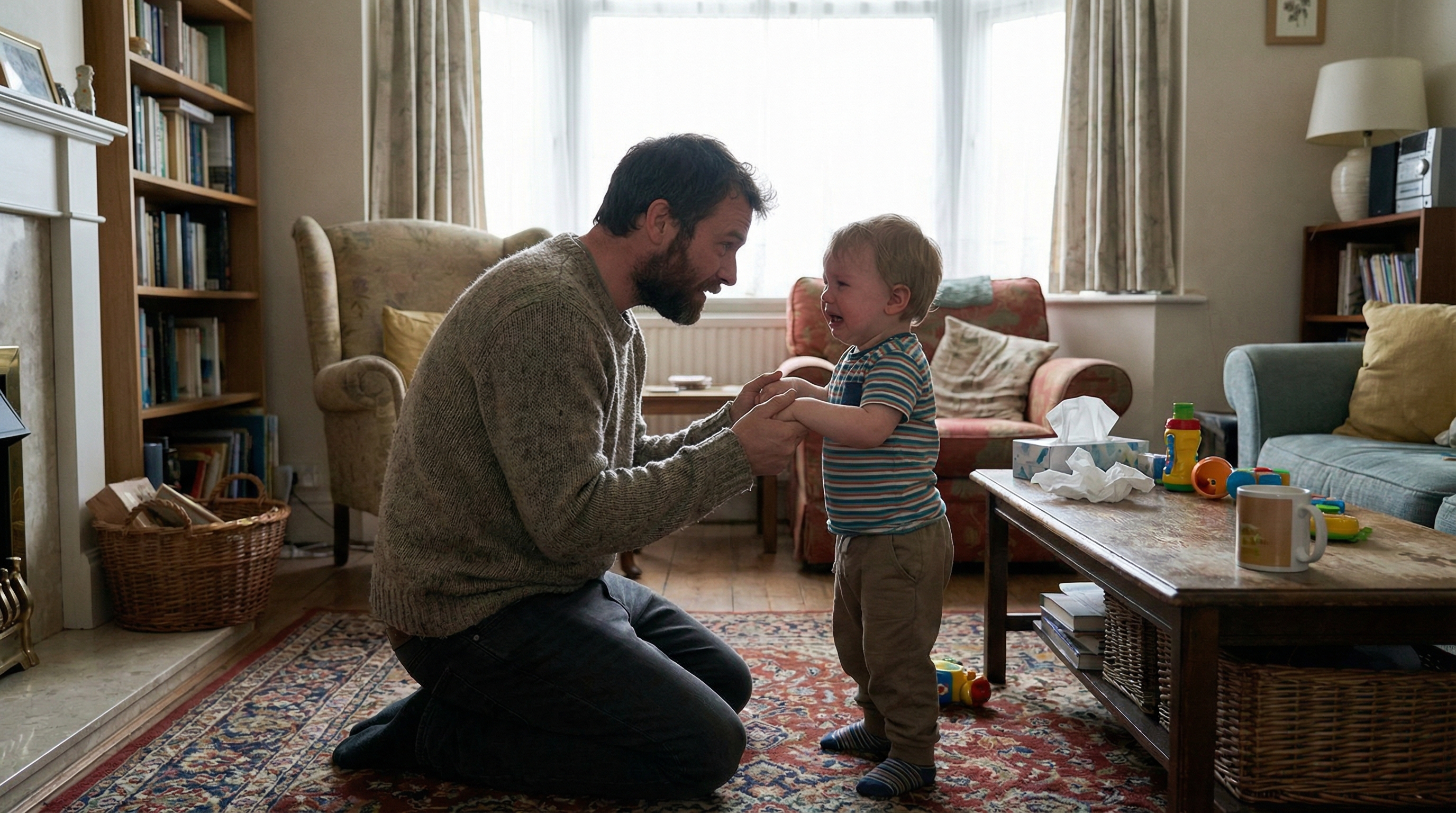

Your toddler is on the floor of Sainsbury's, screaming like you've told them Father Christmas is cancelled, because you gave them the blue cup instead of the red one. And honestly? You're fighting the urge to lie down next to them.
Toddler tantrums are one of the defining experiences of early fatherhood - and one of the least well-explained. Most of the advice out there either assumes you have infinite patience, or suggests techniques that theoretically work in a calm, well-rested state but fall apart completely at 7pm after a full day at work.
This guide is for toddler tantrums as dads actually experience them. The brain science (kept simple), why dads often respond differently, what's actually happening across the three stages of a tantrum, and how to stay functional when you're running on empty.
Why Toddlers Have Tantrums (Brain Science, Kept Simple)
Here's the one thing worth understanding, because it changes everything: your toddler is not doing this to you.
The part of the brain responsible for emotional regulation - managing big feelings, thinking before acting, calming down after being upset - is the prefrontal cortex. It won't be fully developed until your child is in their mid-20s. At age 2 or 3, it is essentially offline when emotions run hot.
When your toddler is overwhelmed - by tiredness, hunger, overstimulation, frustration, or a transition they didn't want - their brain is flooded with stress hormones. The emotional, reactive part of the brain takes over. And in that state, they genuinely cannot calm themselves down without help. They don't have the circuitry yet.
This means two things for you as a dad:
- Logic doesn't work during a tantrum. Trying to reason with a toddler mid-meltdown is like trying to negotiate with someone in the middle of a panic attack. The brain isn't available for reasoning right now.
- They need your nervous system to calm theirs. Co-regulation is the technical term. When you stay calm, your toddler's brain actually takes cues from yours. Your steadiness is the intervention.
It's not naughtiness. It's neurology. That frame doesn't make it less exhausting - but it does make it less personal.
Why Dads Often Respond Differently (and Why That's OK)
A lot of dads notice that they respond to tantrums differently from their partner. Sometimes more reactive - quicker to frustration, more likely to raise their voice. Sometimes more detached - physically present but emotionally checked out. Often worse in the evening.
There are a few reasons for this, and none of them are character flaws.
The 7pm problem
If you're working during the day and coming home at 6pm, you're arriving at what parenting researchers sometimes call "the arsenic hour" - the period before dinner and bed when toddlers are at peak tiredness, hunger, and emotional fragility. You haven't had a warmup. You've gone from work stress straight to toddler chaos. That's a hard transition.
The fix-it instinct
Many dads are conditioned (by personality, upbringing, or culture) to fix problems. A screaming toddler feels like a problem to solve. But tantrums aren't problems to solve. They're storms to ride out. Trying to fix, bargain, or logically address a tantrum usually escalates it. This can feel deeply counterintuitive.
Unfamiliarity with the emotional register
If you've spent less time with your toddler day-to-day than your partner has, you may be less familiar with their particular patterns - what sets them off, what helps, what the early warning signs look like. That's not a reflection of how much you care. It just means there's a learning curve, and the best way to close that gap is time.
The fact that you respond differently from your partner is not necessarily a problem. Research into co-parenting consistently shows that toddlers benefit from having two adults who interact with them in somewhat different ways. Your approach - even the more physical, roughhousing style many dads have - plays a genuine developmental role. For more on how becoming a dad reshapes your sense of self and your patterns, read: Identity Crisis After Becoming a Dad
Want the full picture on the toddler years?
Sleep, tantrums, discipline, play - all in one place. Evidence-based, dad-tested, no fluff.
Get The New Dad Playbook - £29The 3 Stages of a Tantrum and What to Do in Each
Not all tantrums look the same, but most follow a rough arc. Knowing where you are in that arc helps you respond more effectively instead of reacting to the noise.
Stage 1: The Build-Up
Something has gone wrong - the wrong snack, the tablet being turned off, not being allowed something. Your toddler is frustrated but still retrievable. This is whining, protest, early crying. The window to redirect or de-escalate is still open - but it's closing fast.
What to do: Get low (physically - crouch to their level). Acknowledge the feeling without giving in to the demand. "I know you really wanted that biscuit. You're disappointed." Don't over-explain, don't threaten, don't engage with the logic of the situation. Short, warm, calm. Offer a distraction if there's a natural one - "shall we go look at something?" Sometimes this works. Sometimes it doesn't and you move to stage two.
Stage 2: The Storm
Full escalation. Screaming, crying, possibly throwing themselves on the floor, hitting, biting, or breath-holding. The brain is flooded. There is no reasoning to be had here.
What to do: Your only job in stage two is to keep everyone safe and not make it worse. That means:
- Don't match their energy. Lower yours deliberately.
- Don't try to talk them down with logic. It won't work and it will frustrate you both.
- Make sure they can't hurt themselves (move hard objects, guide them away from stairs).
- Stay physically nearby. Don't storm off or threaten abandonment. You can sit quietly in the same room without engaging directly.
- Don't give in to whatever triggered it. Caving at peak tantrum teaches that screaming works.
- Keep your voice low and your body language calm. You are the weather system they're trying to borrow stability from.
Stage 3: The Recovery
The peak is passing. The crying becomes less frantic. They may reach for you, or slump. This is the window to reconnect.
What to do: Offer a cuddle if they want one. Don't lecture about what just happened - their brain is too depleted. A simple "that was hard, wasn't it" is enough. If they're old enough to talk, a brief, warm debrief later (not immediately) can help build emotional vocabulary over time. For now, just be there.
Common Triggers and How to Reduce Them
You can't prevent every tantrum. But you can reduce the frequency by understanding what stacks the deck against your toddler.
The big four: tired, hungry, overstimulated, transitioning
Most tantrums have one or more of these underneath them. A toddler who is tired and hungry is a toddler primed to explode. Watch for the signs - the glazed eyes, the clinginess, the drop in frustration tolerance - and try to get ahead of them.
- Tired: Protect nap time and bedtime routine. Don't push through tiredness hoping they'll "get a second wind." They won't. They'll melt down instead.
- Hungry: Low blood sugar is a real thing. Keep snacks available, especially around transitions.
- Overstimulated: Too much noise, too many people, too many choices. Toddlers have a much lower threshold than adults. A busy soft play at 4pm is a recipe for disaster.
- Transitions: Toddlers hate transitions. Leaving the park, turning off the TV, stopping play to eat dinner - these are high-risk moments. Warnings help: "Five more minutes, then we're going." Then actually follow through.
The control piece
Toddlers are desperate for autonomy - they're just figuring out that they're their own person. A lot of tantrum triggers boil down to feeling like they have no control. Offering small, real choices (not fake ones) can reduce this dramatically: "Do you want to put your shoes on first or your coat?" Both options get you out the door. They get to choose. Everyone wins more often.
The dad-specific trigger: inconsistency
If the rules are different with you than with your partner, your toddler will test the boundaries constantly - not out of cunning, but because they're genuinely trying to figure out how the world works. Getting on the same page with your partner about expectations, boundaries, and responses to certain behaviours reduces the chaos for everyone.
When to Worry (vs. Normal)
Tantrums are normal. They are developmentally expected. Most of what you're experiencing, no matter how intense it feels, is within the range of typical toddler behaviour.
That said, it's worth speaking to your GP or health visitor if:
- Tantrums are happening multiple times a day and are very severe
- They regularly last more than 25 minutes
- Your child is consistently hurting themselves during tantrums (head-banging hard enough to cause injury, for example)
- Tantrums are accompanied by breath-holding spells that cause your child to lose consciousness
- You're noticing other developmental concerns alongside the tantrums
- You're struggling to cope - your own anger, anxiety, or distress about the tantrums is affecting your daily life
That last one is important. If you find yourself losing your temper in ways that scare you, or if the intensity of these situations is bringing up something darker - rage, despair, feelings of failure - please talk to someone. Your GP is a good first stop. You're not a bad dad for finding this hard. You're a human being under real pressure. Read more about this: Anger After Becoming a Dad: What's Normal and What's Not
Staying Calm When You're Knackered
This is the part nobody talks about honestly enough.
All the advice above - stay calm, lower your energy, be a steady presence - is genuinely useful. It's also significantly harder to execute at 7:15pm after a difficult commute, when you haven't eaten properly since lunch, when the house is chaos and your toddler is having their third meltdown of the evening.
Here's what actually helps, practically:
The physiological sigh
Double inhale through the nose (two short sniffs), then a long exhale out through the mouth. This activates the parasympathetic nervous system faster than a normal deep breath. It takes about three seconds. It actually works. Use it the moment you feel your frustration rising.
The internal reframe
When a tantrum hits, your brain's threat response fires. One of the fastest ways to interrupt that is to silently narrate what's happening in non-personal terms: "Their brain is flooded. This is biological. This is not about me." It sounds daft. It genuinely helps interrupt the reactivity cycle.
The tag-out
If your partner is there, use the tag system. If you feel yourself close to the edge - voice getting tight, jaw clenching - signal to your partner and swap. Walk into another room, take three minutes, come back. This isn't failure. This is sensible management of a two-person resource.
The longer game
You can't run on empty indefinitely. If the tantrums are hitting you harder than they should, it's usually a sign that your own reserves are depleted. Sleep, exercise, time away from the house, conversation with other dads who get it - these aren't luxuries. They're what makes the rest sustainable. The identity shift of becoming a dad is real and ongoing - and worth taking seriously.
"Your toddler doesn't need a perfect dad. They need a present one who comes back to calm."
That's the whole job. Not getting it right every time. Coming back to calm.
Frequently Asked Questions
Why do toddlers have tantrums?
Toddlers have tantrums because the part of their brain responsible for emotional regulation (the prefrontal cortex) isn't developed yet - and won't be fully developed until their mid-20s. When they're overwhelmed by emotion, they literally cannot calm themselves down without help. It's not naughtiness. It's neurology.
How long do toddler tantrums last?
Most tantrums last between 2 and 15 minutes. The peak of the tantrum (the loudest, most intense part) usually passes within a few minutes if you don't escalate it. Trying to argue, reason, or discipline during a tantrum extends it - the brain is flooded with stress hormones and cannot process logic.
What age do toddler tantrums start and stop?
Tantrums typically start between 12 and 18 months as toddlers develop wants and opinions but lack the language to express them. They usually peak between 2 and 3 years old - the famous "terrible twos" - and reduce significantly by ages 4 to 5 as language and emotional regulation improve.
Should you ignore a toddler tantrum or intervene?
Ignoring a tantrum in the sense of staying calm and not feeding it works. Literally leaving the room or ignoring your toddler completely is less effective. The research suggests the best approach is calm presence: stay near, don't react emotionally, don't lecture, offer comfort when the storm starts to pass.
When should I worry about toddler tantrums?
Seek advice from your GP or health visitor if tantrums are very frequent (multiple severe ones per day), last a long time (more than 25 minutes regularly), involve self-harm (head-banging hard enough to cause injury), are accompanied by breath-holding spells causing the child to lose consciousness, or if you're concerned about your child's development or your own ability to cope.
Why do my toddler's tantrums seem worse with me than with their mum?
This is very common and it's actually a sign of a healthy attachment. Children often "save" their biggest emotions for the people they feel safest with. If your toddler melts down more with you, it may mean they trust you to handle it. It can also be down to differences in routine, energy levels, or simply timing - 7pm with a tired dad after a long day at work is harder than 2pm on a Saturday.