
You are about to read a lot of rules. Most of them sound obvious. None of them are new. All of them matter more than anything else you will do in the first year.
Sudden Infant Death Syndrome, the thing we never want to say out loud, is rare. It is also mostly preventable. The single biggest drop in infant mortality in the last forty years came from one piece of advice: put babies to sleep on their back. That one rule has saved tens of thousands of lives since the 1990s.
You do not need to be anxious about this. You need to be boring. Boring saves babies. This is the guide to being boring correctly.
What SIDS actually is (and is not)
Sudden Infant Death Syndrome is when a baby under 12 months dies in their sleep with no explanation found even after a full investigation. It is rare. In the UK, around 200 babies die from SIDS each year out of roughly 600,000 born. In the US, the rate is higher, around 1,250 babies per year, but the absolute numbers are still small compared to births.
SIDS is not the same as suffocation. Suffocation from unsafe bedding, sleeping on a sofa, or being rolled onto in an adult bed is a different, also-preventable cause of death. Public health advice bundles them together as "sleep-related infant death" because the same rules prevent both.
The risk window is clear. SIDS is highest between 2 and 4 months. It drops sharply after 6 months and is rare after 12. That is the window where every nap matters and every rule applies.
The one rule above all
Always put your baby on their back to sleep. Every nap. Every night. Until their first birthday. If you remember nothing else from this article, remember this.
The safe sleep rules, in order of how much they matter
There are a lot of these, and they can feel overwhelming. They are not all equally important. Here they are, ranked by the evidence on risk reduction.
1. Back to sleep, every time
Babies who sleep on their stomach or side have up to 45 times the SIDS risk of babies sleeping on their back. This single rule has reduced SIDS deaths by more than 50 percent since public health campaigns started pushing it in the early 1990s.
This applies to every sleep, including short naps in the day. "Tummy time" awake is great and necessary. Tummy sleep is not, ever, until they can roll both ways independently. If your baby rolls onto their stomach on their own and you cannot roll them back without them immediately flipping again, that is the point where you start every sleep on their back but leave them in whatever position they end up in. This is usually around 4 to 6 months.
2. Firm, flat, empty sleep surface
The mattress must be firm and flat, not inclined, not a memory-foam adult mattress, not a bouncer. Inclined sleepers have been linked to infant deaths and were recalled in the US. Flat means flat, even when they have reflux. Reflux does not change the safe sleep rules.
The crib should be empty. No loose blankets. No pillows. No crib bumpers, padded or mesh. No soft toys. No positioners, wedges, or rolls. If your baby needs to be warm, dress them in a sleep sack or wearable blanket. If you were given a beautiful quilt at your baby shower, it goes on a chair for photos. Not in the crib.
3. Room share, do not bed share
The AAP and NHS both recommend baby sleeping in the same room as the parents for at least the first six months, ideally the first twelve. Room sharing (separate crib or bassinet in your room) reduces SIDS risk by around 50 percent. The mechanism is not fully understood but likely involves parents being close enough to hear changes in breathing and babies having more arousal cues from adult presence.
Room sharing is not bed sharing. Your baby should have their own sleep surface, in your room, close enough that you can see and hear them.
Never safe: sofa sleeping
Falling asleep with your baby on a sofa, armchair, or couch is up to 50 times more dangerous than putting them in a crib. If you are doing 3am feeds on the sofa and start to feel sleepy, wake your partner or put the baby down. This is the single highest-risk situation you will face.
4. Room temperature between 16 and 20 degrees
Overheating is a real risk factor. Keep the room between 16 and 20 degrees Celsius (61 to 68 Fahrenheit). Dress your baby in no more than one layer more than you would wear yourself. Feel the back of their neck or chest (not hands or feet, which run cold) to check temperature. If they feel hot or sweaty, strip a layer.
A sleep sack with the right tog rating for the season is the simplest solution. Most come with a chart showing what to wear underneath at different room temperatures.
5. No smoking, no vaping
Smoking during pregnancy and exposure to second-hand smoke after birth both significantly raise SIDS risk. This includes vaping. If you smoke, keep it outside and change your clothes before handling the baby. If your partner smoked during pregnancy and you have not quit, this is the moment. Not tomorrow.
6. Breastfeeding and pacifiers
Breastfeeding is associated with lower SIDS risk. If it works for your family, great. If it does not, do not panic, the other rules matter more. For more on how dads can support feeding, read our guide to breastfeeding support.
Pacifiers at nap and bedtime have been shown to reduce SIDS risk. If you are breastfeeding, wait until feeding is well established (usually 3 to 4 weeks) before introducing one. If the pacifier falls out during sleep, you do not need to put it back in. It only helps when it helps.
What dads specifically need to handle
Most safe sleep content is written for mums, which is weird because dads do at least half the night shifts and a lot of the setup work. Here are the pieces that tend to fall to dads and where dads make mistakes.
Setting up the crib before baby arrives
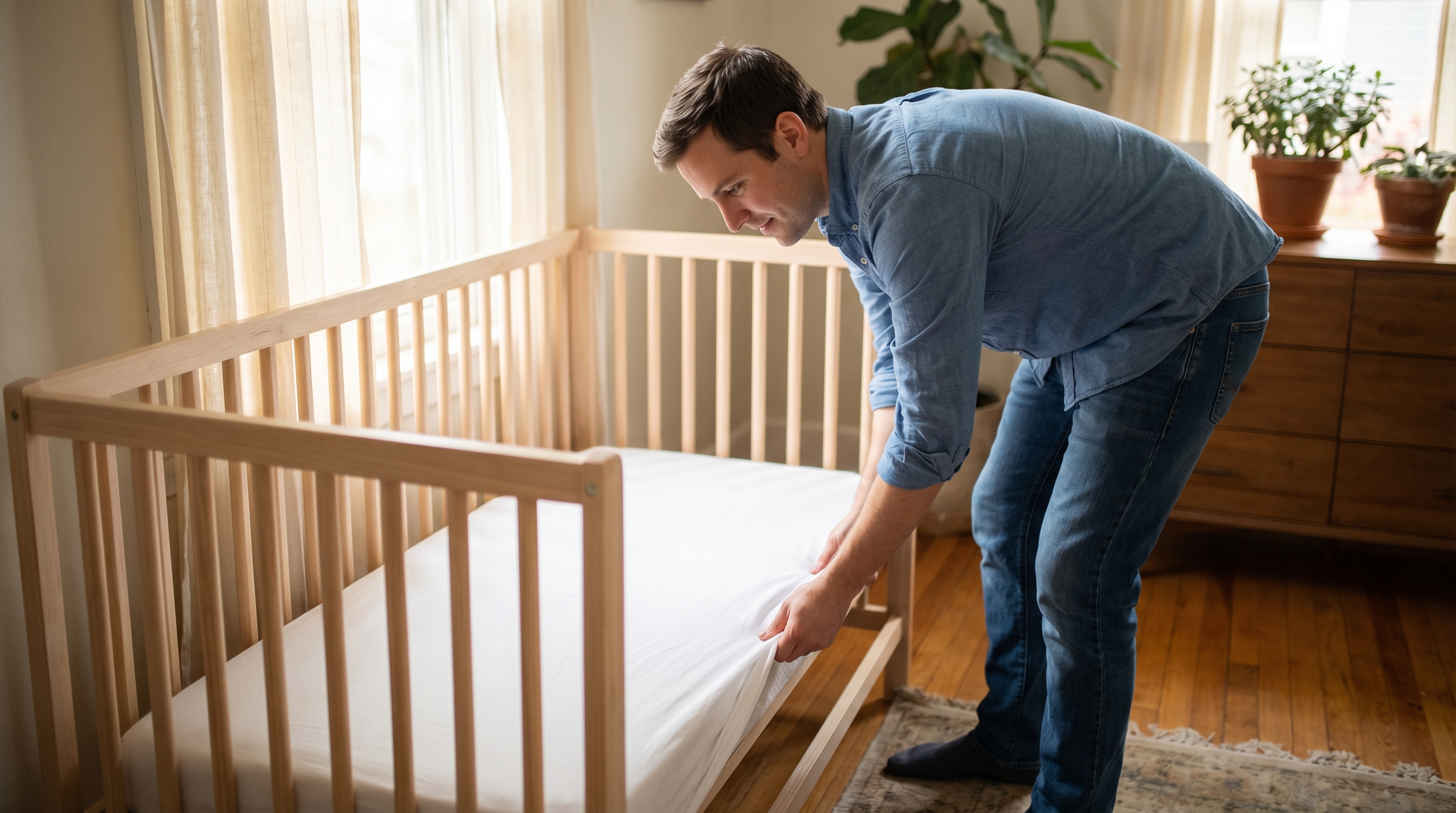
Dads often build the crib. Good. A few things to check when you do:
- Mattress sits flush against all four sides with no gaps wider than two fingers.
- The mattress is firm, not soft. Press your hand on it. If it leaves a deep dent, it is too soft.
- The crib has not been recalled. Check the manufacturer and model against your country's recall database.
- Do not use second-hand mattresses from outside your family. Old mattresses have been linked to higher SIDS risk, possibly due to bacteria.
- Remove any drop-side or broken hardware. Drop-side cribs are banned in the US and UK for safety reasons.
Night feeds on the sofa
If you are the one doing bottle or expressed milk feeds at 3am, the sofa is not your friend. You are exhausted, the baby is warm on your chest, and you will pass out. This is the highest-risk scenario in the whole safe sleep picture.
Do the feed sitting upright on a hard chair, or in bed with the lights on. When they are done, put them back in the crib. Do not "just rest your eyes for a minute" on the sofa with the baby on you. You will not rest for a minute. You will sleep for an hour. Covered in the full story of 3am feeds in our sleep deprivation survival guide.
Naps in the car seat, pram, or baby carrier
Baby sleeps in the car seat on the drive home. Fine. Baby sleeps in the car seat for three hours on the lounge floor. Not fine. Car seats are not designed for extended unsupervised sleep. The semi-reclined position can restrict their airway, especially in young babies with weak neck control.
Rule of thumb: car seats for transit only. If they fall asleep in one, transfer them to a flat sleep surface as soon as you get home. Same rule for bouncers, swings, and inclined loungers. These are not sleep spaces.
Baby carriers and slings are safe for short daytime naps if you follow the TICKS rule: Tight, In view at all times, Close enough to kiss, Keep chin off chest, Supported back. Do not use a sling for overnight sleep.
Bed sharing: what the guidance actually says
This is the area where official advice is firm and real-life practice is messy. The AAP and NHS both advise against bed sharing. The Lullaby Trust says the same. They are not wrong about the risks.
However, they also acknowledge that many parents will end up bed sharing at some point, especially during breastfeeding, and that pretending otherwise leaves parents without safety information. So here is the honest version.
Bed sharing is especially dangerous if any of these apply
- Either parent smokes, now or during pregnancy
- Either parent has drunk alcohol or taken drugs or drowsy medication
- Either parent is extremely tired or unwell
- The baby was premature (under 37 weeks) or low birth weight (under 2.5kg)
- The baby is under 3 months old
- You are on a sofa, waterbed, or memory-foam mattress
If none of those apply and you are going to bed share anyway, the safer-bed-sharing setup is: firm mattress, no pillows near the baby, no duvet near the baby (keep your covers at waist level), baby on their back between the two of you or on the outside with a guard rail, no other children or pets in the bed. But the safest option is always putting the baby back in their own crib once the feed is done.
What does not prevent SIDS
You will see a lot of products marketed as SIDS prevention. None of them have been shown to work.
- Owlet socks and Snuza monitors: Pulse oximeter and breathing monitors have not been proven to reduce SIDS. They create false alarms that cause anxiety and false reassurance that can lead to skipping the basics.
- Anti-roll wedges and positioners: Specifically warned against by the US Consumer Product Safety Commission. Linked to infant deaths.
- Crib bumpers, padded or mesh: Banned in the US as of 2022 under the Safe Sleep for Babies Act.
- Special mattresses marketed as "breathable" or "SIDS-safe": No evidence they work. Stick to a standard firm crib mattress.
- Home apnea monitors: Used medically for specific premature babies. Not for general home use.
Spend your money on a good sleep sack and a room thermometer. Save the rest.
Want the complete Dad Playbook?
Safe sleep, soothing, feeds, and everything else from pregnancy to age two. Evidence-based, dad-tested, no fluff.
Get The New Dad Playbook - £29When to call the doctor
Most of the sleep-related worries you will have are normal. Babies breathe irregularly. They make weird noises. They go quiet for what feels like too long. The rule is: if they are the right colour and warm to the touch, they are probably fine.
Call 111 or your doctor if your baby:
- Is unusually floppy or limp
- Has a bluish or grey tint to their skin or lips (cyanosis)
- Is making a high-pitched or grunting noise with each breath
- Has a very high or very low temperature
- Is breathing very fast, over 60 breaths per minute when settled
- Is not responding normally
Call 999 (UK) or 911 (US) if they stop breathing or you cannot wake them. For more on when to escalate, see our guide to knowing when to call the doctor.
The bottom line
Safe sleep is the most boring, repetitive, high-stakes part of the first year. You will do it right hundreds of times before anything significant happens. That is the job. Boring is good. Boring is what keeps everyone alive and asleep.
Back. Flat. Firm. Empty. Their room or yours, not your bed. 16 to 20 degrees. No sofa. For 12 months. That is the whole thing.
If you are anxious about this, that is normal. New dad anxiety is common and treatable. The rules are not a punishment. They are a set of simple actions that take the decision-making out of the moment. Set up the crib right once, and then you do not have to think about it at 3am.
Frequently asked questions
What is the single biggest thing I can do to reduce SIDS risk?
Put your baby on their back to sleep, every single time, for every nap and every night, until they are 12 months old. Back sleeping is the single most important intervention. Babies who sleep on their stomach or side have up to 45 times higher SIDS risk. This rule alone has reduced SIDS deaths by more than half since it became standard guidance in the 1990s.
Is it safe to let my baby sleep on me on the sofa?
No. Falling asleep with a baby on a sofa, armchair, or couch is one of the highest-risk situations for SIDS and fatal suffocation. The Lullaby Trust calls this out specifically. If you feel yourself getting drowsy while holding the baby on a sofa, wake your partner, put the baby in their crib, or stand up. Sofa sleeping increases SIDS risk up to 50 times.
When can I stop following safe sleep rules?
Follow the rules for every sleep until your baby is 12 months old. SIDS risk is highest between 2 and 4 months, but remains elevated through the first year. Once they can roll both ways on their own, you can leave them in whatever position they roll into, but you still start every sleep on their back.
What about swaddles and sleep sacks?
Sleep sacks (wearable blankets) are recommended and safe because they cannot cover the face. Swaddles are fine for newborns on their back, but stop swaddling the moment your baby shows any sign of rolling (usually 8 to 12 weeks). A swaddled baby who rolls onto their front cannot push up and is at very high risk.
Is it dangerous to have my baby in bed with us?
The Lullaby Trust and NHS advise against bed sharing, and it is especially dangerous if either parent smokes, has been drinking alcohol, has taken drugs or medication that makes them drowsy, if the baby was premature or low birth weight, or if you are extremely tired. If you want to feed in bed, set up the space safely (firm mattress, no pillows or duvet near the baby) and move them back to their own crib before you sleep.
Do breathing monitors and anti-roll wedges help?
No. The AAP and NHS both state that no product prevents SIDS. Breathing monitors and pulse oximeter socks have not been proven to reduce SIDS and can create false reassurance. Anti-roll wedges and inclined sleepers have been linked to infant deaths and are specifically warned against. Stick to the basics: back sleeping, firm flat mattress, empty crib, room sharing.
Sources: NHS safe sleep guidance, The Lullaby Trust, American Academy of Pediatrics 2022 safe sleep policy, CDC SUID and SIDS guidance.