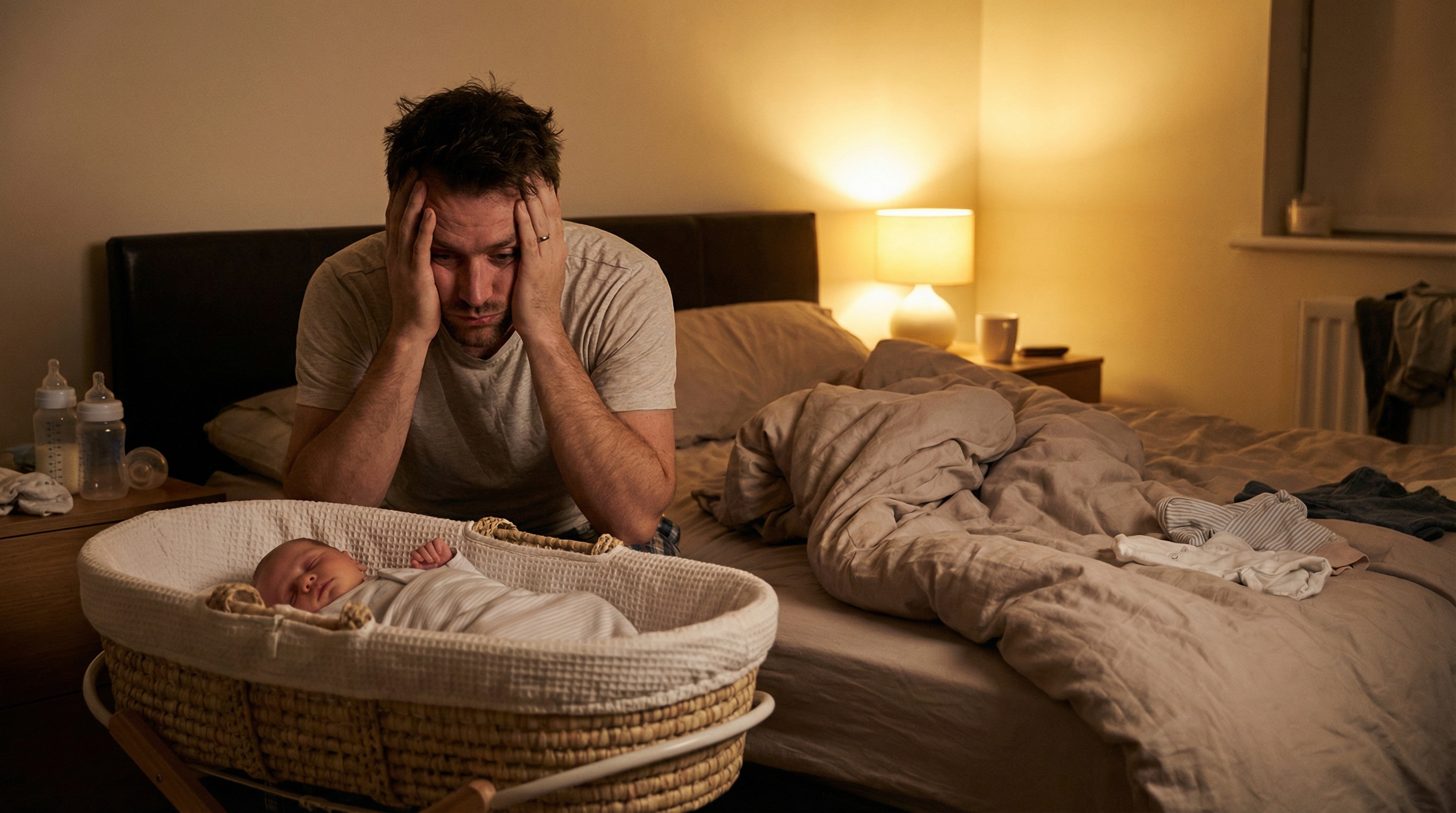


It's 2:47am. The baby is finally asleep. You should be asleep. But you can't switch off.
You keep thinking: what if they stop breathing? What if I drop them? What if something goes wrong and I'm not quick enough? You've checked the baby monitor three times in the last ten minutes. Your chest feels tight. Your jaw is clenched. You lie there in the dark, mind running at full speed, exhausted but utterly unable to rest.
If this sounds familiar - you're not losing it. You're not weak. You're experiencing something that affects a huge number of new dads, and almost none of them talk about it.
This is new dad anxiety. And it's more common, more treatable, and more understandable than you think.
What New Dad Anxiety Actually Feels Like
Anxiety in new dads doesn't always look the way you'd expect. It's not necessarily panic attacks or dramatic breakdowns. Often it's quieter, more persistent, and easy to dismiss as just "being a worried dad."
Here's what it actually tends to feel like:
Intrusive thoughts. These are unwanted mental images that pop into your head - imagining dropping the baby, picturing a car accident on the way to the hospital, or suddenly visualising something awful happening to your child. They feel horrifying, but having them doesn't make you a bad person or a danger. They're a symptom of an anxious brain in overdrive.
Hypervigilance. You're permanently on high alert. Scanning for threats. Noticing every sound. Checking whether the baby is breathing every time the room goes quiet. You can't fully relax even when there's no real danger present.
Constant checking and reassurance-seeking. Googling symptoms at 3am. Asking your partner "do you think they're okay?" repeatedly. Reading horror stories online. Re-reading the same advice looking for certainty that doesn't exist.
Physical symptoms. Chest tightness. A knot in your stomach. Shoulders so tense they ache. An inability to fully exhale. Your body is stuck in threat mode, and it shows up physically.
The inability to switch off. Even when the baby is settled and everything is calm, your brain won't let you rest. You're mentally running through every possible thing that could go wrong.
Sound familiar? You're not alone. And there are real reasons this happens.
Why New Dad Anxiety Happens
Understanding why you feel this way doesn't make it disappear - but it can take the edge off. Anxiety feels less terrifying when you know what's driving it.
Your threat detection system has gone into overdrive. From an evolutionary standpoint, your brain is doing exactly what it evolved to do. You've just become responsible for a tiny, completely defenceless human. Your brain has shifted into maximum protection mode. The problem is that your ancient threat-detection hardware wasn't designed for the modern world - it can't distinguish between "genuine danger" and "worried thought," so it fires at both.
Sleep deprivation amplifies everything. Your brain's threat response centre (the amygdala) becomes significantly more reactive when you're sleep deprived. The rational, calming part of your brain (the prefrontal cortex) gets dampened. The result: threats feel bigger, fears feel more real, and you have fewer internal resources to manage them. This isn't weakness - it's neuroscience.
Your identity has fundamentally shifted. You've gone from being someone who is primarily responsible for yourself to someone responsible for another human being's survival. That's enormous. The person you were before doesn't quite fit anymore, and that loss of a familiar identity - something many dads experience as a full identity crisis after becoming a dad - can manifest as anxiety and a sense of not being in control.
Loss of control. Babies are unpredictable. You can do everything right and still have a bad night. You can't fix it with effort or logic or willpower. For people who cope by feeling in control, this is deeply unsettling.
None of this is a character flaw. It's your brain responding to a genuinely overwhelming set of circumstances.
Normal Anxiety vs. Anxiety Disorder: Where's the Line?
There's a difference between anxiety that's uncomfortable but manageable, and anxiety that is starting to interfere with your life.
Normal new dad anxiety looks like: worrying about the baby's health, having some intrusive thoughts, checking on them more than strictly necessary, feeling on edge during the early weeks. It comes and goes. It doesn't stop you functioning. It eases as you gain confidence and as sleep improves.
Clinical anxiety looks like: worry that is persistent and excessive, that doesn't respond to reassurance, that interferes with your ability to work, sleep, or maintain relationships. It might include panic attacks, avoidance of situations that trigger it, or thoughts that feel completely out of control. It doesn't tend to ease on its own with time.
Around 10% of new dads experience clinical anxiety - not just the standard worry that comes with new parenthood, but an actual anxiety disorder that warrants support. That's one in ten. You are not a statistical outlier. You are not uniquely broken.
The distinction matters because clinical anxiety is treatable. But many men white-knuckle through it alone, convinced they should just man up and get on with it. Please don't. That's not strength - that's suffering unnecessarily.
Want the complete guide?
Everything from pregnancy to age two. Evidence-based, dad-tested, no fluff.
Get The New Dad Playbook - £29What Actually Helps
There's no single fix for new dad anxiety, but there are things that genuinely work. Here are the ones worth starting with.
Name It
This sounds almost too simple, but it matters. When an anxious thought arrives, try saying - internally or out loud - "this is anxiety, not reality." You're not dismissing the feeling. You're reminding your brain that the thought is a symptom, not a fact.
"I might drop the baby" is an anxious thought. It doesn't mean you're going to drop the baby. Naming the anxiety creates a small but meaningful distance between you and the thought.
Use Grounding Techniques
When anxiety spikes, your nervous system needs something to interrupt the spiral. Two of the most effective:
5-4-3-2-1: Name 5 things you can see, 4 you can feel, 3 you can hear, 2 you can smell, 1 you can taste. It sounds simple but it genuinely pulls your brain into the present moment and out of the catastrophic future.
Box breathing: Breathe in for 4 counts, hold for 4, breathe out for 4, hold for 4. Repeat 4 times. This activates your parasympathetic nervous system - the part of your body that tells it "we're okay, we can calm down now."
These won't cure anxiety, but they can break the acute spiral when it's at its worst.
Treat Sleep Like Medication
This one is hard with a newborn, but it matters more than almost anything else. Sleep deprivation and anxiety are deeply linked. Every hour of sleep you can get is a genuine intervention for your mental health.
That means: take shifts with your partner so you get some unbroken sleep, not just fragmented dozing. Say yes when someone offers to help so you can rest. Protect sleep windows fiercely, even if it means letting other things slide.
Talk to Your Partner About Specific Worries
Not just "I'm anxious." That's hard to respond to. Try naming the specific worry: "I keep worrying that we'll miss something wrong with the baby." "I lie awake thinking about what would happen if I made a mistake."
Specific worries are things your partner can actually engage with. Often, hearing someone else calmly acknowledge that a fear is understandable - but unlikely - is more helpful than any amount of internal reasoning.
Exercise, Even When You Don't Want To
You don't have the time. You don't have the energy. You don't feel like it. Do it anyway.
Exercise is one of the most evidence-backed interventions for anxiety that exists. Even a 20-minute walk - in daylight, without the pram if possible - changes the neurochemistry of your brain in ways that reduce anxiety. It's not about fitness. It's about giving your threat-response system somewhere to discharge.
Stop Doom-Scrolling Parenting Horror Stories
The algorithm will serve you your worst fears on a loop if you let it. Every "my baby had a rare condition" post, every terrifying Reddit thread, every 3am Google spiral - they feed the anxiety rather than relieving it. You're not gathering useful information. You're catastrophising with extra steps.
Set a rule: no parenting forums after 9pm. No Googling symptoms unless you've already decided you're calling the GP. Your brain will thank you.
When to Get Professional Help
If anxiety is persistent, severe, or interfering with your daily functioning, please reach out for support. This isn't failure - it's the same logic as going to the GP for a broken arm.
In the UK, the most accessible route is NHS IAPT (Improving Access to Psychological Therapies). You can self-refer - no GP required - at iapt.nhs.uk. Wait times vary, but it's free and effective.
You can also speak to your GP. Be honest with them - tell them you're experiencing persistent anxiety since your baby arrived. They can refer you for therapy, discuss medication if appropriate, or connect you with other local support.
If anxiety is severe or you're experiencing symptoms that feel unmanageable, a private therapist - particularly one trained in CBT (Cognitive Behavioural Therapy) - can often see you much faster.
If what you're experiencing feels deeper than anxiety - if you feel detached, hopeless, numb, or like you're struggling to connect with your baby or partner - that may be paternal postnatal depression, which is a different but equally common and treatable condition. Read our guide to paternal postnatal depression for more.
A Word on Shame
Men are taught, in a hundred subtle and not-so-subtle ways, that feelings like anxiety are not for them. That worrying makes you weak. That the correct response to difficulty is to push through and say nothing.
This is wrong, and it causes real damage. Untreated anxiety doesn't get better by being ignored. It tends to get worse, and it leaks into every corner of your life - your relationship, your parenting, your work, your health. For many dads it surfaces as anger after becoming a dad before they recognise the anxiety underneath it.
Asking for help - whether that's talking to a partner, calling a GP, or sitting with a therapist - is not weakness. It is, in fact, exactly what a good dad does. Because your child needs you to be okay. Not just present. Actually okay.
You don't have to earn that.
FAQ: New Dad Anxiety
Is it normal to feel anxious as a new dad?
Yes, completely. Most new dads experience some level of anxiety - worry about the baby's health, fear of making mistakes, feeling overwhelmed by the responsibility. Mild to moderate anxiety in the early weeks and months of parenthood is extremely common and doesn't mean something is wrong with you. Around 10% of new dads experience clinical anxiety that warrants professional support. Either way, you're not alone.
Why am I so anxious after having a baby?
Several things happen at once: your brain's threat-detection system shifts into overdrive as it adjusts to being responsible for a newborn, sleep deprivation makes your threat response much more reactive, your identity shifts significantly, and you're facing a level of unpredictability and lack of control that's genuinely hard to adapt to. The anxiety is your brain responding to a genuinely demanding situation - not evidence of weakness.
How long does new dad anxiety last?
For most dads, anxiety eases as you gain confidence, as sleep improves, and as the relentless intensity of the early weeks gives way to more of a routine. Many men notice significant improvement by 3–6 months. If anxiety is persistent, severe, or getting worse rather than better, that's a signal to seek support - it's unlikely to resolve on its own at that point.
What helps with new dad anxiety?
Practical things that genuinely work: naming anxious thoughts as thoughts rather than facts, grounding techniques (5-4-3-2-1, box breathing), protecting sleep ruthlessly, talking to your partner about specific worries, exercising even when you don't feel like it, and limiting doom-scrolling parenting horror stories online. For clinical anxiety, CBT therapy is the most evidence-backed treatment.
When should I see a doctor about anxiety?
If anxiety is interfering with your ability to function - your sleep, your work, your relationship, your ability to care for your baby - it's time to seek help. In the UK, you can self-refer to NHS IAPT therapy at iapt.nhs.uk without needing a GP referral. You can also speak to your GP, who can refer you for therapy or discuss other options. There's no threshold of suffering you need to reach before you're "allowed" help - if you're struggling, that's enough.
The New Dad Playbook is a practical guide for first-time dads covering everything from the hospital to the first two years. Get the ebook for £19 or the full bundle for £29.