

Babywearing is one of the best things you can do as a new dad. Hands free, baby happy, bonding happening without you even trying. But there is a safety side to it that does not get enough attention, and getting it wrong has real consequences.
Young babies, especially under four months, have limited head and neck control. Their airways are small and easily blocked. A carrier that positions them incorrectly can restrict breathing, and because babies cannot cry or make noise when they cannot breathe, you might not notice until something is very wrong.
This is not meant to scare you off babywearing. It is meant to make you confident doing it properly. The safety framework is simple: five rules, easy to check, and once they are habit you will not think twice about them. If you are new to carriers and wraps, start with our complete babywearing guide for dads first, then come back here for the safety deep dive.
The TICKS checklist: five rules for safe babywearing
The TICKS checklist was developed by the UK Sling Consortium and is endorsed by the Royal Society for the Prevention of Accidents (RoSPA). It applies to every type of carrier: wraps, ring slings, structured carriers, mei tais. Every time you put your baby in, run through these five checks.
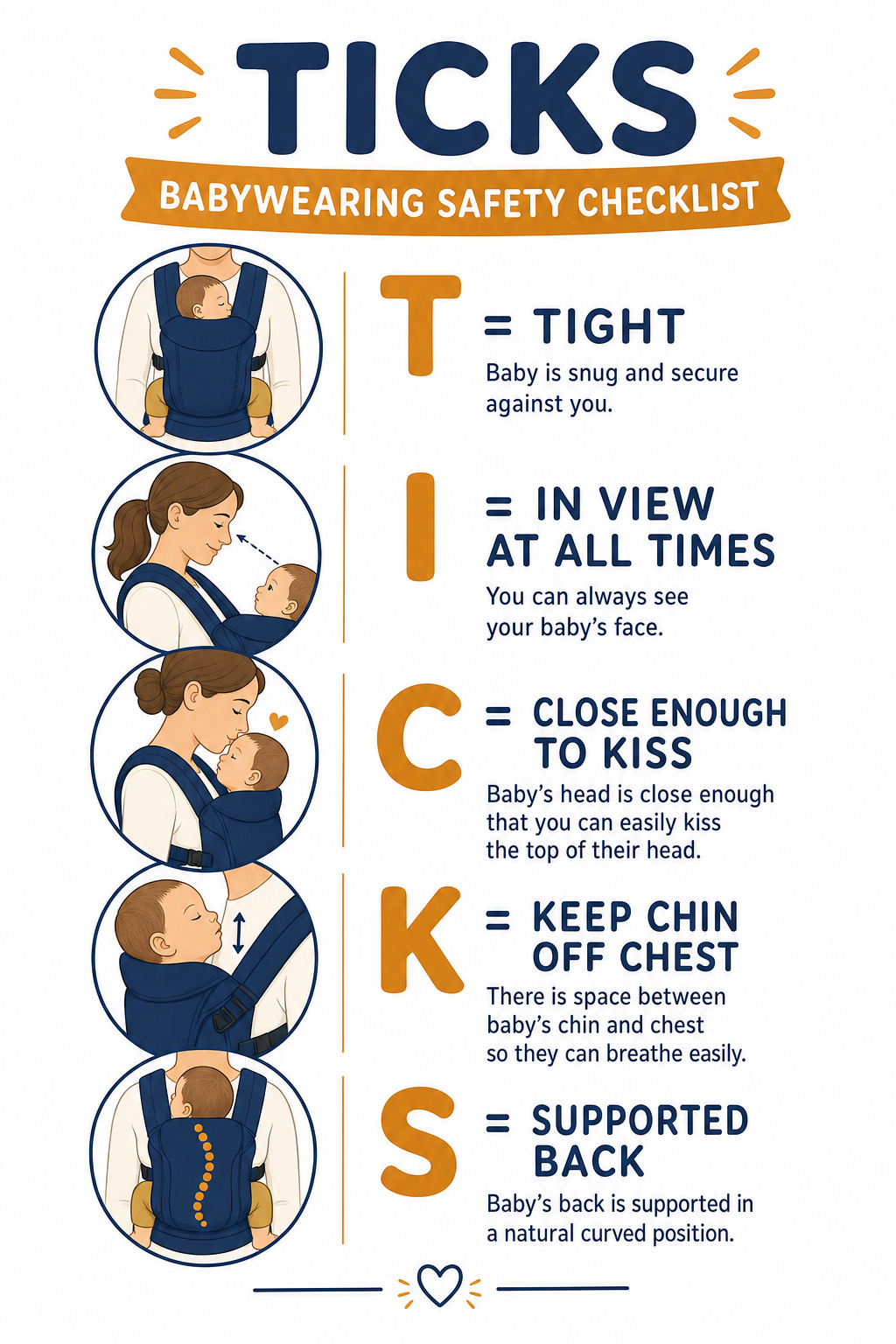
T: Tight
The carrier should hold your baby snug against your body. You should feel like you are moving as one unit, not like you are carrying a bag that swings away from you when you lean. A loose carrier allows your baby to slump into a chin-on-chest position, which is the single biggest risk factor for positional suffocation.
How to check: lean forward slightly. If your baby stays pressed against your chest and does not shift position, the fit is right. If they slump or sag, tighten the carrier until they feel secure.
I: In view at all times
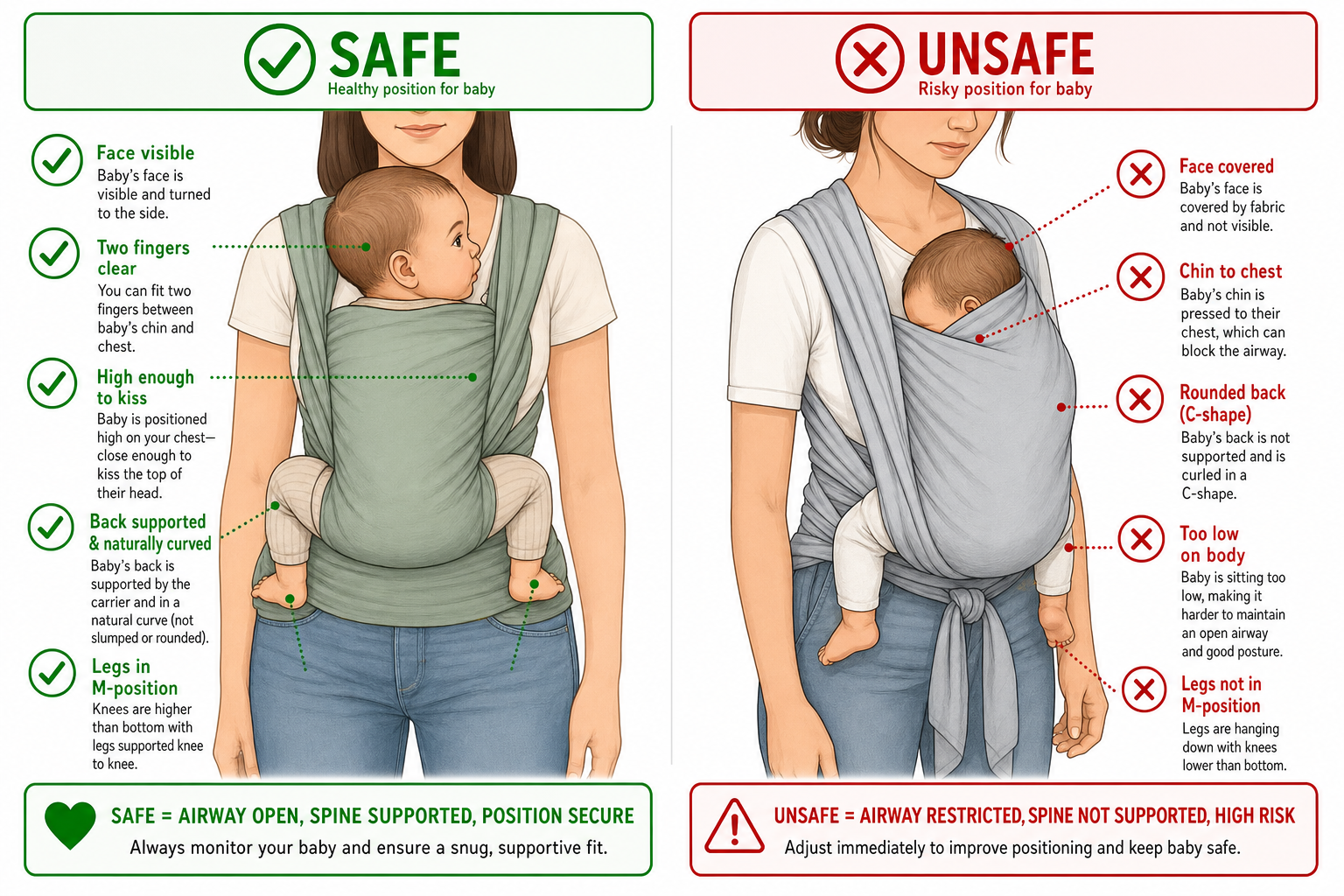
You should be able to see your baby's face at any time just by glancing down. Their face should never be covered by fabric, by the carrier panel, or pressed against your body in a way that blocks their nose and mouth.
This is especially important with stretchy wraps and ring slings, where fabric can ride up. Get in the habit of checking every few minutes, particularly in the first weeks when you are still getting used to the carrier.
C: Close enough to kiss
Your baby should be positioned high enough on your chest that you can tip your head down slightly and kiss the top of their head. If you have to bend at the waist or crane your neck to reach them, they are too low.
A baby positioned too low puts strain on your back and, more importantly, makes it harder to monitor their breathing and face position. The top of their head should be at or above your collarbone.
K: Keep chin off chest
This is the most critical safety point. A baby whose chin is pressed against their chest can have their airway restricted. In very young babies with no head control, this can happen silently and quickly.
You should always be able to fit at least one finger (ideally two) between your baby's chin and their chest. Their head should be turned slightly to one side or tilted back enough that there is a clear gap.
S: Supported back
Your baby's back should be supported in its natural position. For newborns, this means a gentle C-curve, not forced straight. The carrier fabric should be smooth and supportive across their entire back, with no gaps or bunching.
Their legs should be in an M-position (also called the spread-squat or frog position): knees higher than their bottom, thighs supported to the knee. This is not just comfortable, it is the position recommended by the International Hip Dysplasia Institute for healthy hip development.
Safe babywearing: the dos and don'ts
Do
- Run the TICKS check every time you put baby in the carrier
- Keep baby facing inward until they have full head and neck control (4 to 6 months minimum)
- Check on your baby frequently, especially newborns
- Bend at the knees, not the waist, when picking things up
- Use an age-appropriate carrier (stretchy wraps for newborns, structured carriers for older babies)
- Practise putting the carrier on over a bed or sofa until you are confident
- Ensure baby's airways are always clear and visible
- Adjust the carrier if anything feels wrong, even if you just put it on
- Support baby's head with one hand while getting the carrier on and off
- Dress baby lightly: your body heat counts as a layer
Don't
- Do not let baby's chin touch their chest
- Do not cover baby's face with fabric
- Do not carry baby facing outward before 4 to 6 months
- Do not cook near hot surfaces or boiling liquids while wearing baby
- Do not cycle, run, or do any activity with a fall risk
- Do not drink hot beverages directly above baby's head
- Do not use a damaged or recalled carrier
- Do not fall asleep while babywearing (especially on a sofa or recliner)
- Do not carry baby in a "cradle" or hammock-style position in a sling (legs curled, face inward)
- Do not ignore baby being unusually quiet or still in the carrier
Want the complete guide?
Everything from pregnancy to age two. Evidence-based, dad-tested, no fluff.
Get The New Dad PlaybookAge-specific safety considerations
Newborns (0 to 4 months)
This is the highest-risk period for babywearing. Newborns have virtually no head control and their airways are small and soft. Stick to inward-facing carries only. Stretchy wraps and carriers with newborn inserts work best because they hold baby snugly without requiring you to tighten hardware around a tiny body.
Check on them constantly in the first weeks. Every few minutes, glance down to confirm their face is clear, chin is off chest, and they are breathing normally. It sounds paranoid; it is just good practice until you develop the instinct for how things should look and feel.
If your baby was premature, had a low birth weight, or has any respiratory conditions, talk to your GP or health visitor before using a carrier. Some babies need extra monitoring that is harder to maintain in a sling.
4 to 6 months
Once your baby has solid head and neck control (they can hold their head up independently during tummy time), you have more options. Forward-facing carry becomes safe, though many experts recommend keeping it to shorter periods. Forward-facing does not support the spine as well as inward-facing and can overstimulate babies in busy environments.
This is also when hip carries become an option, which many dads find more comfortable as the baby gets heavier.
6 months and beyond
Structured carriers with proper lumbar support become essential as your baby's weight increases. Back carries are an option once your baby can sit independently (usually around 6 months), but practise getting them on and off over a soft surface first. It takes a few tries to get the confidence for the "superman swing" onto your back.
At this age, the TICKS rules still apply, but your biggest risks shift from airway obstruction to physical safety: baby grabbing things off shelves, reaching for hot drinks, or leaning unexpectedly when you are near obstacles.
The most dangerous position: what to watch for
The position most associated with babywearing accidents is the "cradle carry" or "hammock" position in bag-style slings. In this position, the baby lies curled with their chin on their chest and their face pressed against the fabric or the wearer's body. Several infant deaths have been attributed to this position.
The UK's Trading Standards and RoSPA advise against bag-style slings entirely for babies under four months. If you use a ring sling or wrap for a cradle-style carry, the same TICKS rules apply: face visible, chin off chest, airway clear. But honestly, for new dads, an upright carry is simpler and safer. There is no good reason to use a cradle position when an upright carry does the job better.
For more on keeping your baby safe during sleep, including why the same positional concerns apply to car seats and bouncers, check our SIDS prevention guide.
Weather and environment safety
A few things that catch people off guard:
- Heat: Your body heat counts as a clothing layer for your baby. On warm days, dress them in one fewer layer than you would otherwise. Watch for signs of overheating: flushed skin, sweating, rapid breathing. Feel the back of their neck rather than their hands (hands are always cool on babies).
- Cold: A babywearing coat or jacket that zips around both of you is safer than wrapping a blanket around the carrier (blankets can shift and cover baby's face). Baby's extremities (hands, feet) need covering even when their core is warm against you.
- Sun: Baby's head is often exposed in a carrier. Use a sun hat and avoid direct sun. Do not drape a muslin or blanket over the carrier to create shade, as this traps heat and restricts airflow.
- Rain: Purpose-built carrier rain covers exist and are worth the money. Umbrellas work but require one hand, which defeats part of the point.
If something feels wrong, stop
Trust your instincts. If your baby seems unusually quiet, if their colour changes, if the carrier does not feel right, if you just have a nagging feeling: stop, take them out, check. Nobody has ever regretted being too cautious with a baby. You can always put them back in once you have confirmed everything is fine.
If your baby is ever unresponsive or you suspect they are not breathing, remove them from the carrier immediately and follow infant CPR steps. Call 999 (or 911). This is extremely rare, but knowing what to do removes the hesitation that costs time.
Frequently asked questions
What age can you start babywearing?
You can start babywearing from birth, provided you use a carrier appropriate for newborns and follow the TICKS safety guidelines. Newborns need extra head and neck support, so stretchy wraps or carriers with built-in newborn inserts work best. If your baby was born prematurely, had a low birth weight, or has any respiratory or medical conditions, speak to your GP or health visitor before using a carrier.
Can you babywear a newborn face out?
No. Newborns should always face inward, towards your chest. Forward-facing carry is not safe until your baby has full head and neck control, which typically happens around 4 to 6 months. Even then, forward-facing should be limited to short periods as it does not support the natural curve of the spine and can overstimulate young babies.
Is it safe to breastfeed in a baby carrier?
You can breastfeed in a carrier, but you must stop what you are doing and give it your full attention. Hands-free feeding while walking around or doing tasks is unsafe. Adjust the carrier to lower baby to breast height, ensure their airway stays clear throughout the feed, and return them to the upright TICKS position immediately after. Never fall asleep while feeding in a carrier.
How do I know if my baby carrier is too loose?
If you can lean forward and your baby slumps away from your body, the carrier is too loose. A properly fitted carrier holds your baby snug against your torso, so when you move, you move as one unit. You should not need to support your baby with your hands during normal standing and walking. If there is visible slack in the fabric or straps, tighten until your baby feels secure but not compressed.
What are the signs a baby is in distress in a carrier?
Check on your baby frequently. Warning signs include: unusually quiet or still behaviour, skin colour changes (pale, blue, or mottled), difficulty breathing or unusual breathing sounds, chin pressed against chest, and face obscured by fabric or pressed against your body. If you notice any of these, remove your baby from the carrier immediately and check their breathing.
Can dads babywear safely with a larger body?
Yes. Most structured carriers and wraps accommodate a wide range of body sizes. Look for carriers with long waist straps and adjustable shoulder straps. Woven wraps come in different lengths (size 6 or 7 for larger wearers). The TICKS rules apply regardless of body size. The key is ensuring baby is positioned high enough on your chest that you can see their face and kiss the top of their head.