
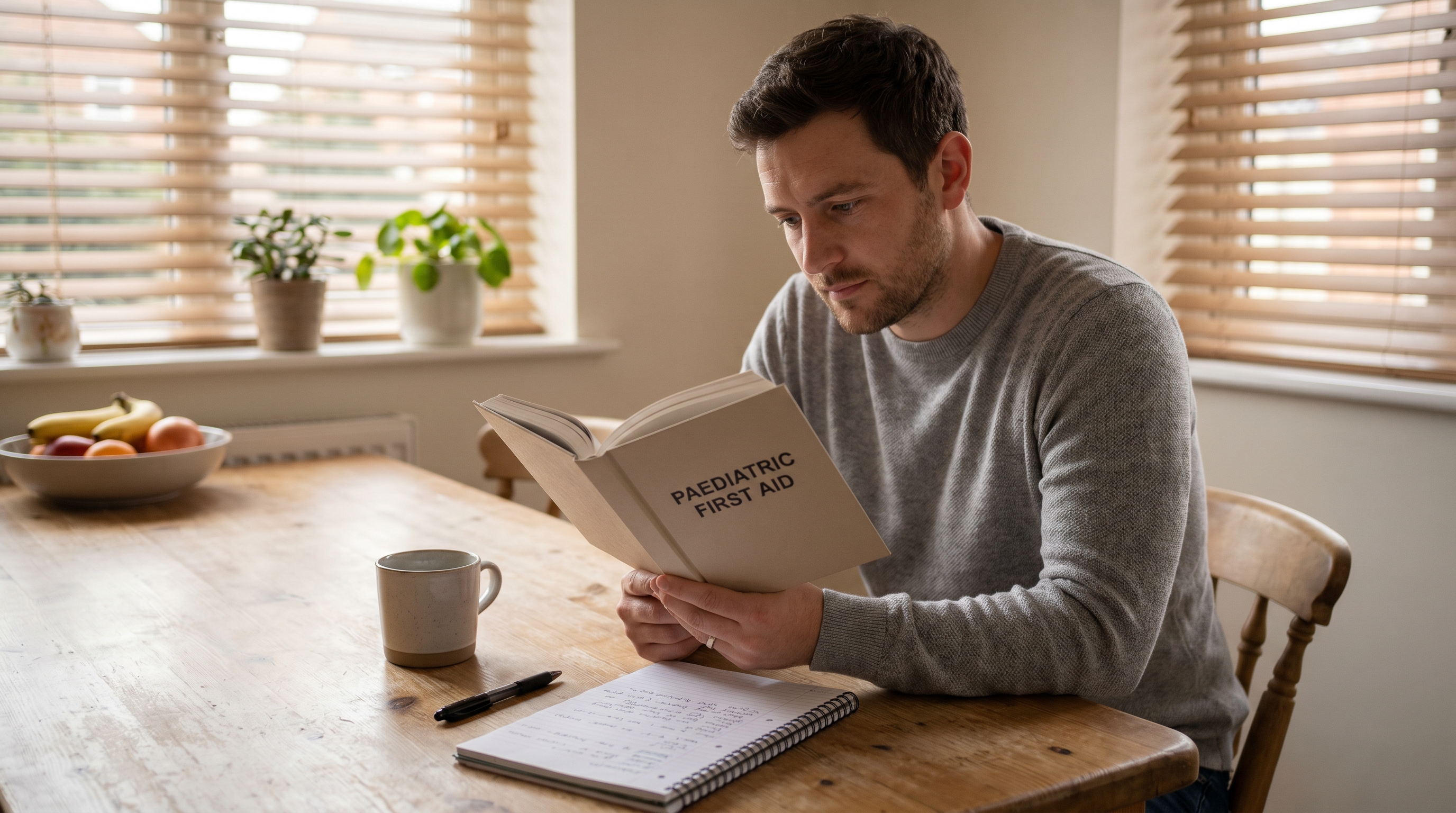
This is the article you hope to never use. It is also one of the most important things you will ever read as a dad. The odds you will need to perform CPR on your own baby are vanishingly small. The cost of being prepared is one boring 8-minute read and ideally one Saturday morning at a first aid class. The cost of not knowing, in the moment when it matters, is the rest of your life.
So sit down with a coffee and read this once, properly. Then book the class. Then forget about it. That is the deal.
This is reference, not training
Reading is not the same as doing. This article will help you remember the sequence in a moment of panic, but it does not replace a hands-on baby first aid course. Book one. Red Cross, St John Ambulance, NCT, or your local community centre. £30 and 3 hours. Do it before they hit 6 months.
The two scenarios you are preparing for
Almost everything dad-related infant emergency falls into one of two buckets:
- Choking. Baby has something stuck in their airway. They are still alive, possibly conscious, but cannot breathe. The intervention is back blows and chest thrusts.
- Cardiac arrest or unresponsive not breathing. Baby is unresponsive, not breathing or only gasping. The intervention is full CPR (chest compressions and rescue breaths).
The two interventions are different. Doing the wrong one for the wrong situation is worse than doing nothing. So the first job is always the same: figure out which one you are dealing with.
How to tell what is happening
If they are coughing or crying
Leave them alone. A coughing baby has an airway and is doing the right thing. A baby crying loudly has air moving. Do not slap them on the back, do not stick fingers in their mouth, do not pick them up and shake them. Stay close. Watch. The cough is doing the job and will almost always clear it.
If they cannot cough, cry, or make sound
This is choking. Their face may go red then blue. They may be making weak high-pitched noises. They may be silently struggling. This is the moment for back blows and chest thrusts. See the choking section below.
If they are unresponsive and not breathing
If you tap their foot firmly and call their name and they do not respond, and they are either not breathing at all or only gasping irregularly, they are in cardiac arrest territory. Skip the choking sequence and start CPR immediately. Send someone to call 999 (UK) or 911 (US) and find an AED.
Infant choking: the exact sequence
For babies under 1 year old who cannot cough, cry, or breathe, the standard sequence from the Red Cross, NHS, and AHA is alternating back blows and chest thrusts. Both work to dislodge the object using pressure from below.
Position the baby face-down on your forearm
Sit or kneel down. Lay the baby face-down along your forearm, with their head lower than their body. Support their head and jaw with your hand. Rest your forearm on your thigh for stability.
Give 5 firm back blows
Using the heel of your free hand, give 5 firm slaps between the shoulder blades. Firm. Not gentle taps. Each one should be enough to potentially shift an object. Check their mouth between blows. If you can see the object loose at the front, hook it out. If not, do not blind sweep.
Turn the baby face-up
Carefully turn the baby over so they are face-up along your other forearm, head still lower than the body, supported on your thigh.
Give 5 chest thrusts
Using two fingers (index and middle) on the centre of the chest, just below the nipple line, give 5 chest thrusts. Push down sharply about 4cm (1.5 inches) and release. These are quicker and more forceful than CPR compressions and are designed to push air out of the lungs to dislodge the object.
Repeat until clear or unresponsive
Alternate 5 back blows and 5 chest thrusts until the object comes out, the baby cries or breathes normally, or they go unresponsive. If they go unresponsive at any point, lay them on a firm surface, send someone to call 999 or 911, and start CPR. Do not call first if you are alone, start CPR for 2 minutes, then briefly stop to call.
Never do abdominal thrusts on a baby under 1
The Heimlich manoeuvre (abdominal thrusts) is for children over 1 and adults. A baby's liver is unprotected by the rib cage and can rupture. Use back blows and chest thrusts only until they hit their first birthday.
Infant CPR: the exact sequence
If your baby is unresponsive and not breathing or only gasping, this is what the 2025 American Heart Association and AAP guidelines say to do.
Check response and shout for help
Tap the baby's foot firmly. Call their name. If no response and not breathing normally (only gasping counts as not breathing), shout for help. If anyone is in earshot, send them to call 999 or 911 and find a defibrillator.
Lay them on a firm flat surface
Floor, table, kitchen counter, the changing mat on a hard surface. Never the sofa or a bed. Compressions need a firm surface to deliver pressure to the heart.
Give 30 chest compressions
Place two thumbs side by side on the centre of the chest, just below the nipple line, with your fingers wrapping around the back of the baby. (If your hands are too small, use two fingers instead, or the heel of one hand.) Push hard, push fast: about 4cm (1.5 inches) deep, at 100 to 120 compressions per minute. Count out loud. Let the chest fully recoil between each push.
Give 2 rescue breaths
Tilt the head back to a neutral position (do not over-tilt: babies' airways are short and over-extending closes them). Cover the baby's nose and mouth with your mouth, making a complete seal. Give 2 small puffs of air, just from your cheeks, just enough to make the chest rise visibly. Each breath about 1 second.
Continue 30:2 cycles
Keep cycling 30 compressions and 2 breaths. If you are alone and have not yet called for help, do 2 minutes (about 5 cycles) of CPR then stop briefly to call 999 or 911. If an AED is available, attach it as soon as possible using paediatric pads or attenuator. Follow the device's voice prompts.
Keep going until help arrives
Continue CPR until paramedics take over, the baby starts breathing on their own, an AED tells you to stop, or you physically cannot continue. Compressions are exhausting. Swap with another person every 2 minutes if possible to keep quality high.
Why dads specifically need to know this
Most baby first aid material is aimed at mums or "primary caregivers", which is not how the data actually works. Dads do roughly half of the bath time, weaning, and unsupervised play in modern households. They are statistically just as likely to be the only adult in the room when something goes wrong.
And here is the awkward truth: in most couples, the partner who has done the first aid course handles the emergency, and the one who has not freezes. Freezing is normal. Untrained brains do not produce calm sequences in moments of acute stress. Trained ones do. The difference is muscle memory, and the only way to build it is hands on a manikin.
If you have read our safe sleep guide, you already know that the highest-risk window for sudden infant death is 2 to 4 months. That is also the window where dads do a lot of the night feeds and naps. Learn this before then.
The most common dad mistakes
Calling 999 before doing anything
If your baby is unresponsive and you are alone, the guidance is to do 2 minutes of CPR before stopping to call. The reason is that for a baby in cardiac arrest, oxygen delivery in the first 2 minutes is the single biggest predictor of survival. If anyone else is around, they call. If not, CPR first, call second.
Compressing too softly
Real CPR compressions feel uncomfortably hard. You are pressing roughly a third of the depth of their chest. Many parents in training pull back because it feels brutal. It needs to be brutal. Cracked ribs heal. A heart that does not get compressed enough does not.
Over-tilting the head for breaths
An infant's airway is short and easily kinked. Over-extending the neck closes it off, which is the opposite of what you want. Neutral position only. The breath should be about the size of a normal puff from your cheeks, not a full lungful.
Slapping them on the back when they are coughing
If they are coughing forcefully, leave them alone. Slapping them mid-cough can dislodge the partial blockage into a full one. Watch and wait. Intervene only if the cough goes silent.
Doing the Heimlich on a baby
Already covered above, but worth repeating: never abdominal thrusts on a baby under 1. Back blows and chest thrusts only.
Want the complete Dad Playbook?
First aid, safe sleep, soothing, feeds, and everything else from pregnancy to age two. Evidence-based, dad-tested, no fluff.
Get The New Dad Playbook - £29How to actually train for this
Reading this article gives you about 20 percent of what you need. The remaining 80 percent comes from putting your hands on a manikin, getting feedback on depth and rhythm, and running through the choking sequence with someone correcting your grip. Three options, in order of how strongly we recommend them:
- In-person baby first aid class. 2 to 3 hours, £30 to £50. Red Cross, St John Ambulance, NCT, or local community centres. Best option by a wide margin. Take your partner.
- Online certified course with practical kit. Some providers send you a manikin in the post. Better than nothing if you genuinely cannot get to a class.
- YouTube refreshers. The British Red Cross channel has excellent free videos. Good for refreshing what you already learned in person. Not a replacement for hands-on practice.
Refresher every 12 to 18 months. Skills decay. The point is not to remember every detail forever, it is to have the muscle memory ready for the moment.
When to call 999 or 911 (and when not to)
Call immediately for:
- Choking that does not clear after the first round of back blows and chest thrusts
- Unresponsive or not breathing
- Blue or grey lips, face, or fingertips
- Drowning or near-drowning, even if they seem fine afterwards
- A serious fall (especially head impact) followed by vomiting, drowsiness, or unequal pupils
- Suspected anaphylaxis (sudden swelling of face or throat, difficulty breathing, hives all over)
For less acute concerns, our when to call the doctor guide covers the line between "ring 111" and "go to A&E". And for the everyday respiratory and fever stuff, see our fever guide.
The bottom line
You will probably never need this. Almost no dad does. But if the day ever comes when you do, the difference between "I have practised this" and "I have never thought about this" is the difference between a story you tell at a future birthday party and one you cannot bring yourself to talk about.
Read this once. Book the class. Refresh every year or two. Forget about it the rest of the time.
Frequently asked questions
What is the difference between infant CPR and adult CPR?
The compression technique is different. Infant CPR uses two thumbs (or two fingers) on the centre of the chest, with much shallower depth (about 4cm or 1.5 inches versus 5 to 6cm for adults). Rescue breaths are small puffs from your cheeks, not full lung breaths, because infant lungs are tiny. The compression-to-breath ratio is the same: 30 to 2 for a single rescuer. The 2025 AHA guidelines specifically note that the two-thumb encircling technique or one-hand heel-of-hand technique is preferred over the older two-finger approach.
What do I do if my baby is choking?
If your baby cannot cough, cry, or breathe and is silent or making high-pitched noises, they are choking. Place them face-down along your forearm with their head lower than their body, supported by your thigh, and give 5 firm back blows between the shoulder blades with the heel of your hand. Then turn them face-up and give 5 chest thrusts (using two fingers on the centre of the chest). Alternate 5 back blows and 5 chest thrusts until the object comes out, the baby cries, or they go unresponsive. If they go unresponsive, start CPR and call 999 or 911.
Should I do abdominal thrusts (the Heimlich) on a baby?
No. Abdominal thrusts are never recommended for babies under 1 year old. A baby's internal organs, especially the liver, are fragile and not protected by the rib cage in the same way as in older children and adults. Abdominal thrusts can cause serious internal injury. Use back blows and chest thrusts instead. From age 1 onward, abdominal thrusts (the Heimlich manoeuvre) become the standard.
Should I sweep my finger in their mouth to remove the object?
No, not unless you can clearly see the object and grab it cleanly. Blind finger sweeps can push the obstruction further down the airway or damage the soft tissue at the back of the throat, causing swelling and making things worse. Look in the mouth between cycles of back blows and chest thrusts. If you see the object loose at the front, hook it out. If you cannot see it, keep going with back blows and chest thrusts.
Do I really need to take a baby first aid course?
Yes. Reading an article is not the same as practising on a manikin. The two-thumb technique, the right depth, and the back blow position only really click when you do them with your hands. Most cities offer 2 to 3 hour baby first aid classes through the Red Cross, NCT, St John Ambulance, or local community centres for £30 to £50. Many companies also offer them as a perk. It is the highest-leverage three hours you will spend in the first year. Take your partner with you.
When should I worry vs let the cough do its work?
If your baby is coughing forcefully, that is good. Their cough is more powerful than anything you can do, and you should let it run. Stay calm, do not slap them on the back while they are coughing, and watch them. The moment the cough becomes silent, weak, or stops while they are still struggling, intervene with back blows and chest thrusts. Silent struggle, blue tinge to the lips, or going floppy means call 999 or 911 immediately and start back blows.
Sources: 2025 American Heart Association and AAP Pediatric Basic Life Support Guidelines, British Red Cross infant first aid guidance, NHS infant choking and CPR guidance, American Red Cross infant CPR programme.