
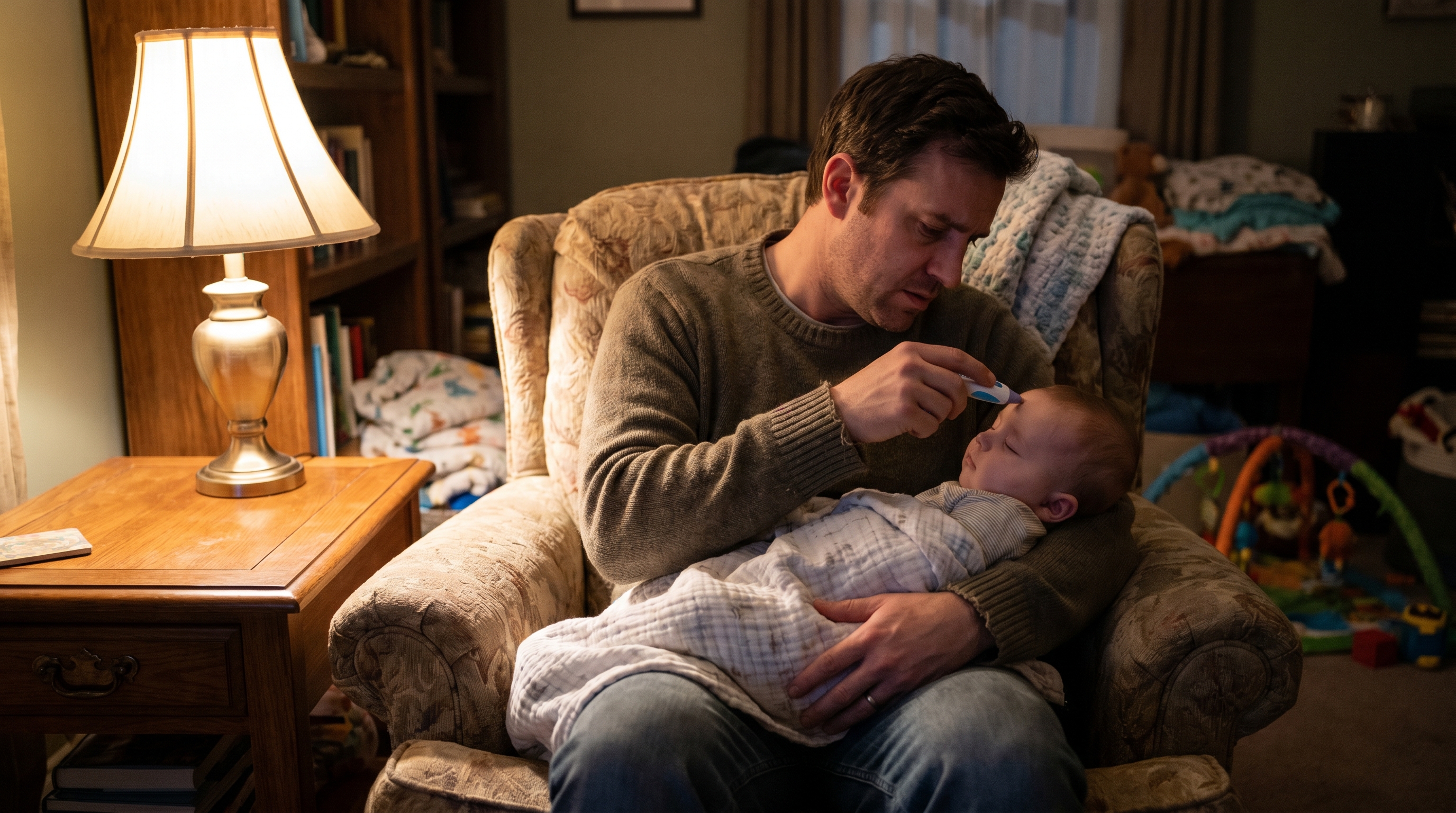
It is 3am. Your baby feels hot. The forehead test confirms it. You stick a thermometer under their arm and the number that comes back makes your stomach drop. Now what.
Baby fever is one of those things that sounds simple until it is your baby. Then it is suddenly the only thing that exists. The good news: most baby fevers are mild, viral, and resolve on their own. The other news: there are specific ages and specific numbers where you do not wait, you act.
This is the guide. Age-by-age temperature thresholds. What to do at home. The exact red flags that mean A&E or 999 right now. Written for dads who need clear answers fast, not vague reassurance.
What counts as a baby fever?
The official threshold from the NHS is 38°C (100.4°F) or higher. Anything below that is not a fever, even if your baby feels warm to the touch. Babies run slightly warmer than adults at baseline, around 36.5 to 37.5°C, so warm is normal. Hot is different.
How you take the temperature matters more than most people realise.
- Under 3 months: use a digital thermometer in the armpit (axillary). Hold it in place for the full reading time.
- 3 to 6 months: axillary still works, or a tympanic (ear) thermometer if you have one. Forehead infrared is convenient but less accurate.
- Over 6 months: any of the above. Forehead strips and pacifier thermometers are not reliable. Bin them.
Take it twice if the first reading surprises you. Make sure they have not just been wrapped in a blanket (which can falsely elevate axillary readings).
The age rules that change everything
The single most important factor in deciding what to do is your baby's age. Younger babies have less developed immune systems and a fever can mean a serious infection that needs immediate treatment. Older babies have more reserves and most fevers are nuisance illnesses.
Age and temperature: when to act
| Age | Temperature | Action |
|---|---|---|
| Under 3 months | 38°C or higher | Same-day medical assessment. Call 111 or GP. |
| 3 to 6 months | 39°C or higher | Call 111 or GP for advice that day. |
| 3 to 6 months | 38 to 38.9°C | Treat at home, monitor closely, call 111 if worried. |
| 6 months and over | Any fever | Treat at home unless red flags appear. |
| Any age | Fever lasting 5+ days | Call GP or 111, regardless of how baby seems. |
The under-3-months rule is non-negotiable. Even if your baby looks fine. Even if they are feeding normally. Even if it is the middle of the night. A temperature of 38°C in a baby under 3 months always needs same-day assessment because serious bacterial infections can present with fever and almost no other symptoms.
The exception: if the fever starts within 48 hours of routine vaccinations and the baby is otherwise well, the NHS says paracetamol is fine and you can wait it out. If you are not sure, call 111 anyway. They will tell you.
Red flags: stop reading, get help now
Some symptoms with a fever change everything. If you see any of these, do not wait, do not try paracetamol first, do not Google more. Call 999 or take your baby to A&E.
999 or A&E now if your baby:
- Has a stiff neck or refuses to bend their neck
- Has a non-fading rash (press a glass against it: if it does not fade, go now)
- Is breathing fast, grunting, or pulling in around the ribs
- Has blue, grey, or mottled skin, lips, or tongue
- Is unusually limp, floppy, or hard to wake
- Has had a fit or seizure
- Has a bulging soft spot on their head (fontanelle)
- Will not stop crying or has a high-pitched, weak cry
- Has a temperature with cold hands and feet (mottled circulation)
The non-fading rash is the classic meningitis sign and the one most worth memorising. Press the side of a clear glass firmly against the rash. If you can still see the rash through the glass and it does not fade, it could be meningococcal septicaemia. Do not wait. Call 999.
For more on knowing when to escalate, read our guide to when to call the doctor about your baby.
Treating fever at home (when it is safe to)
If your baby is over 3 months, the fever is under 39°C, and there are no red flags, home care is appropriate. The goal is comfort, not aggressively forcing the temperature down. A fever is the immune system doing its job. Mild fevers actually help fight infection.
The basics
- Fluids: offer breastmilk or formula more frequently. Older babies on solids: small sips of water often. Dehydration makes everything worse.
- Strip a layer: remove a layer of clothing or bedding. Do not bundle them up to "sweat it out." That myth needs to die.
- Cool room, not cold: aim for 16 to 20°C (the same temperature you would set for safe sleep, see our safe sleep guide). Open a window if needed. No fans pointed directly at the baby.
- Skin to skin: a calm cuddle helps regulate them and lets you monitor their temperature naturally.
Medication: paracetamol and ibuprofen
Both are appropriate for treating discomfort from fever, but the NHS does not recommend giving them just to bring a temperature down. Use them when your baby seems distressed, in pain, or unable to settle.
- Infant paracetamol: from 2 months if born after 37 weeks and over 4kg. Follow weight-based dosing on the bottle.
- Infant ibuprofen: from 3 months if over 5kg. Give with food or milk.
- Do not combine: never give both at the same time. Alternating them is sometimes advised by NHS 111 for stubborn fevers, but only if a clinician has told you to do that.
- Never: aspirin (under 16), adult cold and flu medicines, or anything labelled "for children 6+ years" if your baby is younger.
What not to do
The internet is full of bad fever advice. Skip the following:
- Tepid sponging or cool baths. The NHS specifically advises against this. Cooling the skin causes shivering, which raises core temperature and distresses the baby.
- Bundling them up to "sweat it out." Overheating makes things worse and is dangerous in itself.
- Aspirin. Risk of Reye's syndrome. Never give aspirin to a child under 16.
- Antibiotics from a leftover prescription. Most fevers are viral and antibiotics do nothing for them. Always check with a doctor.
Want the complete Dad Playbook?
Fevers, sleep, feeds, and everything else from pregnancy to age two. Evidence-based, dad-tested, no fluff.
Get The New Dad Playbook - £29Common causes of baby fever
Most baby fevers are caused by viral infections that resolve on their own in 3 to 4 days. The most common culprits:
- Common cold: snotty nose, cough, mild fever. Usually 3 to 5 days.
- Roseola: 3 to 4 days of high fever (often 39 to 40°C) followed by a pink rash that appears as the fever breaks. Typical between 6 and 24 months.
- Hand, foot and mouth: fever, sore mouth, blisters on hands and feet. 7 to 10 days.
- Ear infection: fever, fussiness, pulling at ears. May need antibiotics.
- Urinary tract infection: fever with no obvious cause, sometimes vomiting. Needs a urine test and likely antibiotics. Don't dismiss an unexplained fever as just a virus, especially if it lingers.
- Post-vaccination fever: common for 24 to 48 hours after jabs. Usually mild, responds well to paracetamol.
- Teething: can cause a slightly raised temperature (under 38°C), but does NOT cause true fever despite popular belief.
What to monitor (the dad-friendly checklist)
If you are managing a fever at home, keep a simple log. It helps you spot patterns and gives a doctor useful information if you do end up calling later. Note:
- Time of each temperature reading and the number. Phone notes is fine.
- Last dose of paracetamol or ibuprofen, and how much. Critical for safe redosing.
- Wet nappies in the last 12 hours. Dehydration risk if fewer than 4 to 6.
- Feeding: how much, how often. Refusing feeds is a yellow flag.
- Behaviour: alert, sleepy, irritable, normal. Trust your gut on this one.
If anything in the red flag list above appears at any point, that overrides everything. Call 999 or go to A&E.
When the worry gets bigger than the fever
Watching your baby be unwell is hard. Watching them be unwell at 3am when you are running on no sleep is harder. If you find yourself in a constant low-grade panic about every temperature reading, that is worth noticing. Health anxiety in new parents is real and common. Read our piece on new dad anxiety if any of this feels familiar.
For most fevers, the right move is the boring one: comfort measures, monitor, ride it out. The dramatic interventions are for the small minority of cases. Knowing the red flags means you can act fast when it matters and not panic when it does not.
The bottom line
Under 3 months and 38°C or higher: same-day medical attention, no exceptions. Over 3 months: treat at home, watch for red flags, paracetamol or ibuprofen for distress not for the number. Any age with red flag symptoms (non-fading rash, breathing problems, floppy, fit, blue lips): 999 or A&E now.
Keep a digital thermometer in the changing bag. Keep infant paracetamol in the cupboard. Save NHS 111 in your phone. That is the kit. Most nights you will not need it. The night you do, you will be glad it is ready.
Frequently asked questions
What temperature is a fever in a baby?
A fever in a baby is a temperature of 38°C (100.4°F) or higher. The NHS uses 38°C as the official threshold. Below that, your baby may feel warm but is not technically running a fever. Always use a digital thermometer under the armpit (axillary) for babies under 3 months, and tympanic (ear) for older babies if you have one.
When should I take my baby to A&E for a fever?
Go to A&E or call 999 if your baby has a fever AND any of these: a stiff neck, a non-fading rash (do the glass test), trouble breathing, blue or grey skin, lips or tongue, is unusually limp or floppy, has a fit or seizure, or you cannot wake them. For babies under 3 months, any temperature of 38°C or higher needs same-day medical assessment, even without other symptoms.
How much paracetamol or ibuprofen can I give a baby?
Infant paracetamol can be given from 2 months if the baby was born after 37 weeks and weighs over 4kg. Infant ibuprofen can be given from 3 months if the baby weighs over 5kg. Always follow the dosage on the bottle by weight, not age. Never give both at the same time, alternate them only if advised by a doctor or NHS 111. Do not give aspirin to children under 16.
Should I sponge my baby with cool water to bring the fever down?
No. The NHS specifically advises against tepid sponging or cool baths. They can cause shivering, which raises core temperature, and can make your baby more distressed. Just remove a layer of clothing or bedding, keep the room cool but comfortable, and offer fluids. The goal is comfort, not aggressively forcing the temperature down.
How long is too long for a baby fever to last?
If a fever lasts 5 days or more, contact your GP or NHS 111 even if your baby seems otherwise well. Most viral fevers resolve within 3 to 4 days. A persistent fever can indicate something needing investigation, like a urinary tract infection, ear infection, or other bacterial illness.
Is teething a cause of baby fever?
Teething can cause a slightly raised temperature, around 37.5°C, but it does not cause a true fever (38°C or higher). If your baby has a temperature of 38°C or above, do not blame teething, look for other causes. The NHS and AAP both confirm teething does not cause significant fevers, despite what your mother-in-law tells you.
Sources: NHS guidance on high temperature (fever) in children, NICE guideline NG143 (fever in under 5s), American Academy of Pediatrics fever guidance, Meningitis Now glass test guidance.