
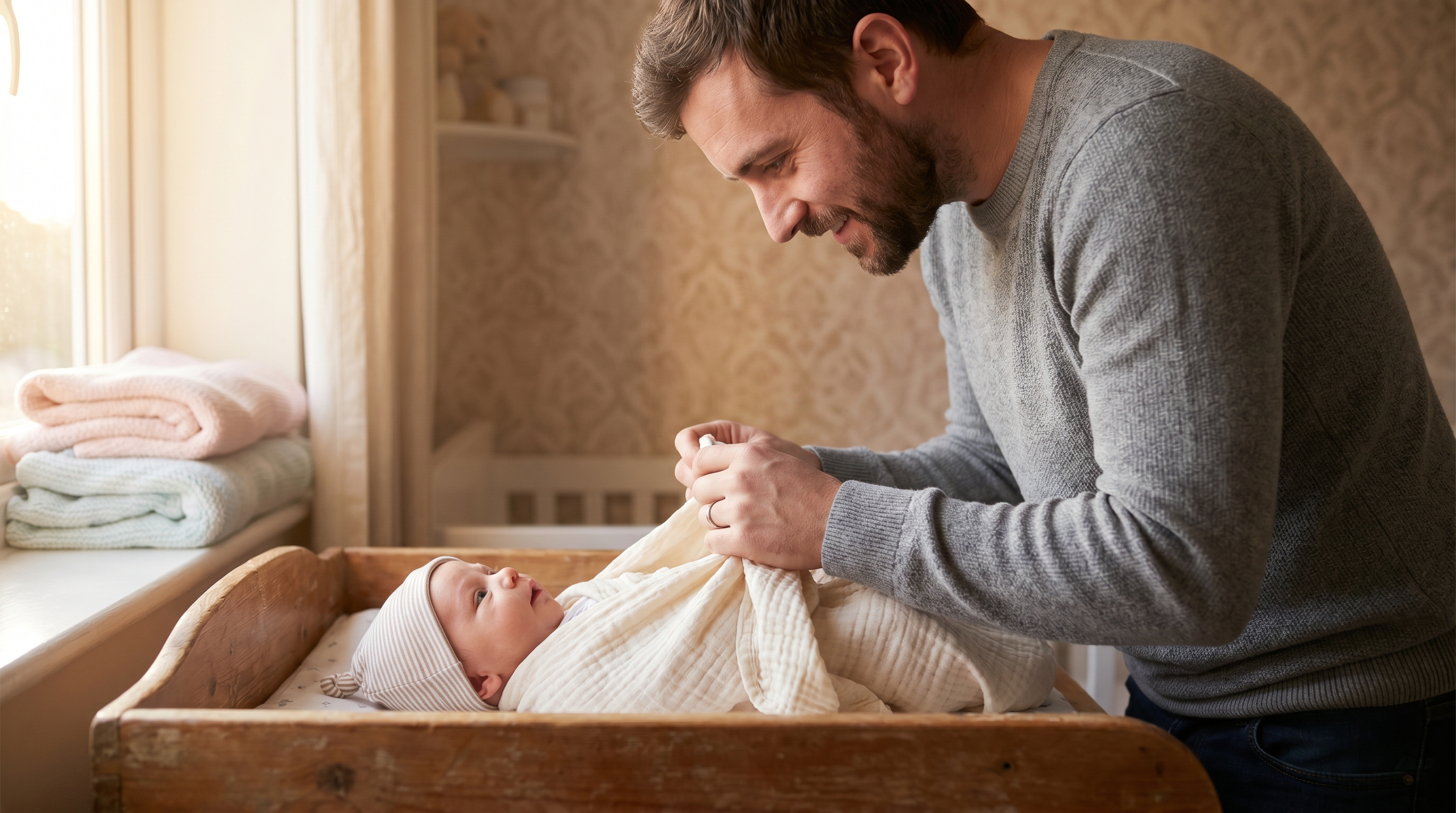
The first time you try to swaddle a baby, the baby wins. They wriggle, they fight, they flail an arm out the moment you tuck the other one in. You stare at the blanket wondering why the midwife made it look like origami. The baby starts to cry. You start to sweat.
Two weeks later, you can do it in 20 seconds in the dark with one hand. This is one of the few new dad skills that actually clicks fast. You just need someone to show you the steps without the 800-word personal essay about how their grandmother used to swaddle.
Here is the swaddle, in plain English, with the safety bits that actually matter.
Why we swaddle in the first place
Newborns come pre-installed with the Moro reflex, also called the startle reflex. Any small noise, sudden movement, or feeling of falling makes their arms shoot out. It looks dramatic. It also wakes them up, which is the entire problem.
A snug swaddle dampens the reflex by holding the arms close to the body. The baby thinks they are still being held. The reflex fires, the arms cannot fly out, the baby stays asleep. The result is longer stretches of sleep, less crying, and a small amount of preserved sanity for everyone in the house.
Swaddling also helps with general fussiness, witching-hour meltdowns, and over-tired babies who cannot shut down. If you have spent any time with our guide to soothing a crying baby, you will know that swaddling is the first of Harvey Karp's classic 5 S's. Wrap, side, shush, swing, suck. Get the wrap right and the rest is easier.
What you need before you start
This part is short.
- A square swaddle blanket, ideally 110cm by 110cm. Lightweight muslin or thin cotton works best. Anything fleecy or weighted is out, weighted swaddles are specifically warned against by the American Academy of Pediatrics.
- A flat, firm surface. Changing table, the middle of a bed, the floor on a soft mat. Not the sofa, not the edge of anything they can roll off.
- A reasonably calm baby. If they are mid-meltdown, feed or burp first, then swaddle. Trying to wrestle a wrap onto a screaming newborn is a losing fight.
If the diamond-fold technique below feels fiddly at 3am, a velcro or zip swaddle (Love to Dream, Halo SleepSack Swaddle, ergoPouch) does the same job in five seconds and is genuinely hard to get wrong. Lots of dads default to these and never go back to muslins. No shame in that.
How to swaddle a baby, step by step
This is the standard diamond fold, the technique recommended by the AAP, NHS, and most paediatric nurses. It is hip-safe when done correctly, which is the part that matters.
Lay the blanket in a diamond and fold the top corner down
Spread the blanket flat on your surface in a diamond shape, with one corner pointing up at the ceiling. Fold the top corner down about 15cm (6 inches), so the top of the blanket now has a straight horizontal edge.
Place baby on their back with shoulders along the fold
Lay your baby on their back on the blanket, with their shoulders sitting just below that straight folded edge. Their head and neck should be above the blanket, never covered. Take a second to make sure they are centred, not crooked, before you start wrapping.
Wrap the first arm and tuck across the body
Hold your baby's right arm gently down by their side, palm flat against their thigh. Take the left side of the blanket, pull it firmly across their chest and over their right arm, and tuck the corner snugly under their left side, behind their back. Snug across the chest, not tight enough to constrict their breathing.
Fold the bottom up loosely over the legs
Bring the bottom corner of the blanket up loosely over your baby's feet. This part is deliberately not tight. Their hips and knees must stay free to bend up and out, the natural frog-leg position newborns assume. Pulling the legs straight is the single most common swaddling mistake and the one linked to hip dysplasia.
Wrap the second arm and tuck across
Hold your baby's left arm down by their side. Take the right side of the blanket, pull it firmly across their chest and over their left arm, and tuck the corner under their body on the right side. The wrap should now feel snug across the chest and arms, but loose around the legs and hips. Their bottom half should look more like a sleeping bag than a sausage roll.
Check the fit before laying baby down
Slide two fingers between the blanket and your baby's chest. There should be a small amount of give, not loose, not so tight you can barely fit a hand in. Gently flex their hips up and out to make sure their legs can move freely. Then place them on their back in the crib. Always on their back. Never side, never stomach.
The two non-negotiables
Swaddled babies sleep on their back, every single time. And the moment your baby shows any sign of trying to roll over (usually 8 to 12 weeks), stop swaddling immediately. A swaddled baby who flips onto their stomach cannot push up and is at very high risk.
Hip-safe swaddling: the part most people get wrong
Pull a baby's legs straight, wrap them tight, and you increase the risk of developmental hip dysplasia. This is well-evidenced. The International Hip Dysplasia Institute, the AAP, and orthopaedic surgeons all warn about the same thing.
The fix is not complicated. The wrap needs to be snug across the chest and arms, but loose enough around the legs that your baby can pull their knees up to their belly and let their hips fall out to the sides. That natural frog-leg position is what their hips are designed to be in for the first months of life.
Hip-safe swaddling, in three points
- Snug at the chest and arms.
- Loose around the hips and legs, with room to bend up and out.
- If you can flex the legs to a frog-leg position without resistance, the hips have enough room.
Velcro swaddles like Love to Dream and Halo are designed with this in mind. They have a fitted top half and a loose hip pouch at the bottom. Hard to get wrong, which is the point.
When to stop swaddling
This is the rule that catches a lot of dads out. It feels counter-intuitive. Your baby finally sleeps in the swaddle. You finally have a system. And then you have to stop.
Stop swaddling the moment you see any sign of rolling. Not when they are reliably rolling. Not when they have done it three times. The first time you see them get half way over, the swaddle comes off. For most babies this is somewhere between 8 and 12 weeks, but it can be earlier.
The reason is brutal but worth being clear on: a swaddled baby who rolls onto their front cannot push up to clear their airway, which substantially raises the risk of suffocation and SIDS. Our safe sleep guide covers this in more detail, but the rule is firm.
Switch to a sleep sack or wearable blanket with arms out. Halo, ergoPouch, and Love to Dream all make transition products with one or both arms free. Many babies have a few rough nights as they relearn how to sleep without the wrap, and then settle within a week.
Common dad mistakes (and the easy fixes)
The wrap is too loose and they Houdini out
The most common dad complaint. They get an arm out, they wake themselves up. Usually because the first tuck was not tight enough, or because the corner was tucked above their body instead of properly under it. The blanket needs to physically pin under their weight.
Fix: lift the baby slightly when you tuck so the corner goes deep under their back, not just folded over. The baby's own body weight is what holds the wrap in place.
The wrap is too tight and they cannot move their hips
If their legs are pinned straight and you can barely flex their hips, you have wrapped the bottom half too tight. Loosen it. Hips need room to bend up and out.
Fix: keep the bottom half of the wrap genuinely loose, almost like a pouch. The snugness goes around the chest and arms only.
The blanket is too small or too thick
A 75cm by 75cm muslin will not give you enough fabric to tuck properly. Get a proper 110cm by 110cm square. A heavy fleece blanket will overheat the baby. Stick to lightweight muslin or thin cotton.
You wrap them when they are over-tired and miserable
Trying to swaddle a screaming newborn is a fight you will lose. Swaddle before they get to that point, ideally 5 to 10 minutes before you expect them to want to sleep, while they are calm-but-alert.
You forget about the room temperature
A swaddle counts as one full layer of clothing. If the room is 22 degrees and your baby is in a footed sleeper plus a muslin swaddle, they will overheat. Keep the room between 16 and 20 Celsius and dress the baby in a single layer underneath. Check the back of their neck or chest, never their hands, to gauge temperature.
What if my baby just hates being swaddled?
Some babies do. Most newborns hate it for the first 30 to 60 seconds and then settle, because the wrap is dampening the reflex that was making them flail. If they fight for 30 seconds and then relax, that is normal and you have done it right.
If they are still fighting after a couple of minutes, options to try:
- Try a one-arm-out swaddle (one arm in, one arm free). Plenty of babies prefer this.
- Try an arms-up swaddle like a Love to Dream, where the arms are wrapped in a folded-up position rather than down. Some babies find this more natural.
- Check whether they actually need a feed, burp, or nappy change. Hunger and wind feel like swaddle-rage to the baby.
- Try without swaddling for a few sleeps and see if it makes a difference. A small minority of babies sleep better unswaddled from day one.
If your baby is consistently miserable in the wrap and fine without it, do not force it. Swaddling is a tool, not a rule. Plenty of newborns sleep brilliantly in a sleep sack with arms free.
Want the complete Dad Playbook?
Swaddling, soothing, sleep, feeds, and everything else from pregnancy to age two. Evidence-based, dad-tested, no fluff.
Get The New Dad Playbook - £29Putting it all together
Swaddling is one of the rare new dad skills that has a clear right answer and a fast learning curve. Snug across the chest and arms, loose around the hips. Always on their back. Stop the moment they start rolling. That is the entire game.
If the muslin-fold method does not click, buy a velcro swaddle. The babies do not know the difference and your sanity will thank you. The first time you wrap your baby, lay them down, and they actually go to sleep, you will feel like you have unlocked a cheat code. For more on what the first weeks of newborn sleep actually look like, read our guide to newborn sleep in the first 6 weeks. And for the witching-hour meltdowns where swaddling alone will not cut it, our colic and fussy-baby guide has the full toolkit.
You will get this in a week. Promise.
Frequently asked questions
When should I stop swaddling my baby?
Stop swaddling the moment your baby shows any sign of trying to roll over, which usually happens between 8 and 12 weeks. The American Academy of Pediatrics is firm on this: a swaddled baby who rolls onto their stomach cannot push up to clear their airway, which dramatically increases the risk of suffocation and SIDS. From that point, switch to a sleep sack with arms out so they can move freely.
Can swaddling cause hip dysplasia?
Yes, but only if you swaddle the legs incorrectly. Wrapping a baby's legs straight and tight increases the risk of developmental hip dysplasia. The fix is simple: keep the wrap snug around the chest and arms, but always loose around the hips so the legs can bend up and out at the knees. The International Hip Dysplasia Institute calls this hip-healthy swaddling, and it is the standard recommended by the AAP and NHS.
Should I swaddle with arms in or arms out?
Arms in is the traditional newborn swaddle and works best for the first 6 to 8 weeks because it dampens the startle reflex that wakes most newborns. As babies start rolling or self-soothing more, transition to arms out (one or both) using a transition swaddle or sleep sack with sleeves. Most dads find arms in is what makes the difference between a baby who sleeps and a baby who flails themselves awake.
What temperature should the room be when my baby is swaddled?
Keep the room between 16 and 20 degrees Celsius (61 to 68 Fahrenheit). A swaddle counts as one full layer, so dress your baby underneath in a single layer (a short-sleeved bodysuit or footed sleeper, depending on the room temp). Overheating is a known SIDS risk factor. Check the back of their neck or chest, not their hands, to gauge temperature. If they feel hot or sweaty, strip a layer.
What kind of blanket should I use to swaddle?
Use a large, lightweight, breathable square blanket, ideally 110cm by 110cm muslin or thin cotton. Avoid heavy, fleecy, or weighted blankets, all of which raise the overheating risk. The AAP specifically warns against weighted swaddles or weighted sleep sacks. If wrapping a traditional blanket feels fiddly, a velcro or zip swaddle (like a Love to Dream or Halo SleepSack Swaddle) does the same job in seconds and is much harder to get wrong.
Why does my baby fight the swaddle?
Most newborns hate being swaddled for the first 30 seconds and love it the moment they settle. The fight is the startle reflex you are actually trying to dampen. If they keep fighting after a minute and start escalating, the wrap might be too tight at the chest, too loose at the arms (so they wriggle out), or they might be hungry, wind-y, or have a dirty nappy. Try one swaddle in arms-out style. Some babies just prefer one arm free.
Sources: American Academy of Pediatrics safe sleep policy, NHS swaddling guidance, International Hip Dysplasia Institute hip-healthy swaddling guidelines, Healthy Children safe swaddling article.