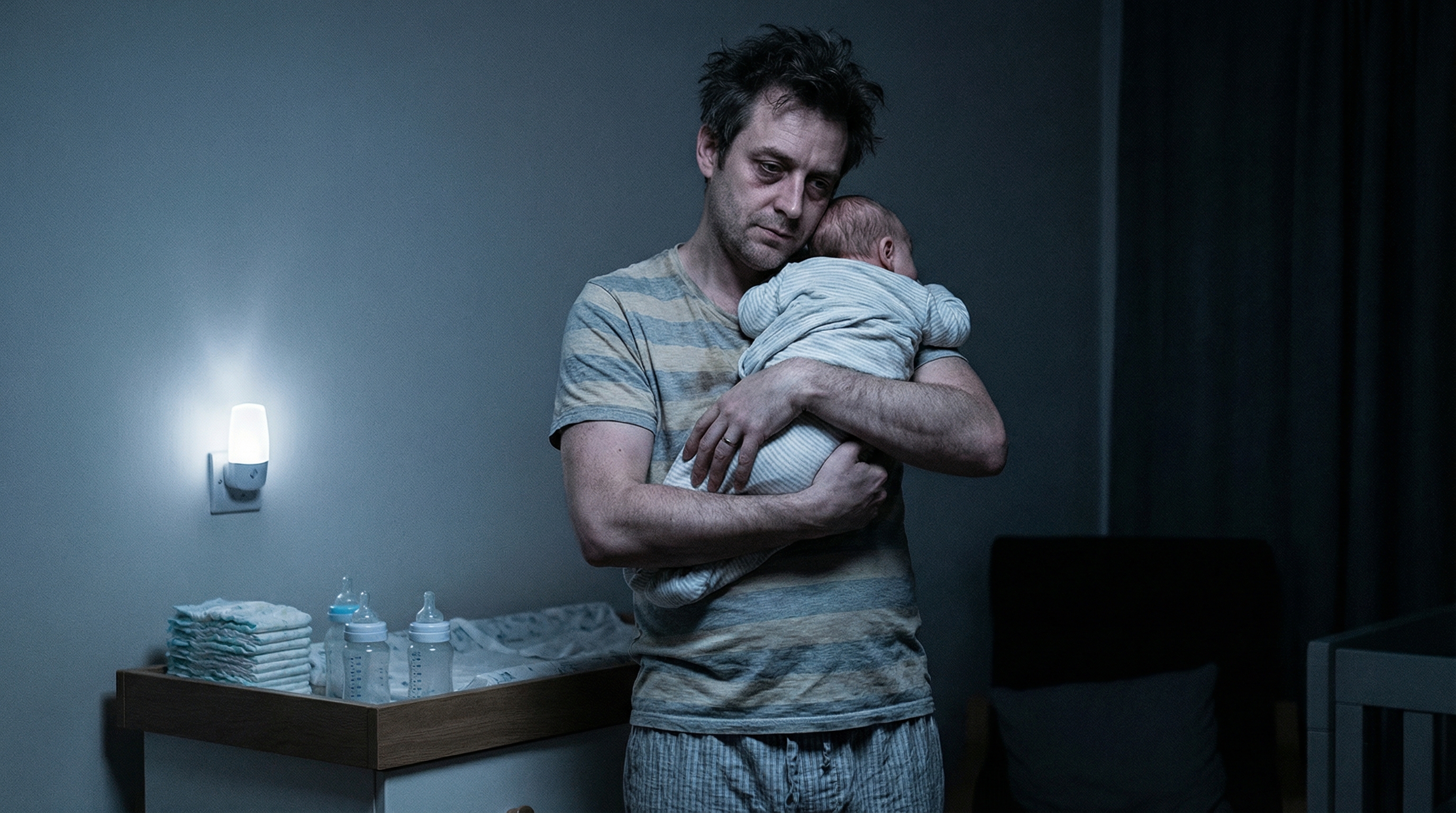
Your baby was sleeping. Maybe not perfectly, but they were doing 4 or 5-hour stretches. You were starting to feel human again. You told someone at work "yeah, we're getting there with sleep."
And then, overnight, it stopped. Now they're waking every 45 minutes. They won't settle. They're crying in a way they haven't cried before. And you're standing in a dark room at 3am, swaying back and forth, Googling "4 month sleep regression" with one eye open.
You're in the right place. Here's what's happening and how to get through it.
TL;DR - The Quick Version
>
What it is: A permanent change in your baby's sleep architecture, not a phase to "fix."
>
Why it happens: Your baby's brain is maturing from newborn sleep patterns (2 stages) to adult-like sleep cycles (4 stages). They now wake between cycles and don't know how to fall back asleep.
>
When it hits: Usually between 3.5 and 5 months.
>
How long it lasts: The worst of it is typically 2–4 weeks. The underlying change is permanent (but manageable).
>
What helps: Consistent routines, dark room, white noise, splitting the night with your partner, not creating new sleep associations you'll regret.
What's Actually Happening (The Science, Simply)
The 4-month sleep regression isn't really a regression at all. It's a progression - your baby's brain is upgrading its sleep software, and the transition is rough.
Newborn Sleep vs. 4-Month Sleep
Before (newborn): Your baby had two stages of sleep - active sleep (REM) and quiet sleep (deep). They'd cycle between these two stages and often sleep through transitions without waking. This is why newborns can sleep through almost anything.
After (4 months): Your baby's sleep matures to include four stages, the same as adults:
- Stage 1 - Light sleep. Drowsy, easily woken.
- Stage 2 - Slightly deeper, but still relatively light.
- Stage 3 - Deep sleep. Hard to wake. This is the restorative stuff.
- REM sleep - Active brain, dreaming, processing.
Your baby now cycles through all four stages roughly every 45–60 minutes at night (adults cycle every 90 minutes). At the end of each cycle, they briefly surface to light sleep.
Here's the problem: they don't know how to fall back asleep when they surface.
As an adult, you do this dozens of times per night without noticing. You briefly wake, adjust your pillow, and drift off. Your baby surfaces, realises they're not being held / fed / rocked - the conditions that were present when they fell asleep - and panics. Cue crying.
The Circadian Rhythm Factor
Around 4 months, your baby's circadian rhythm - their internal body clock - starts properly developing. Their brain begins producing melatonin (the sleep hormone) in response to darkness, and cortisol (the wake-up hormone) in response to light.
This is a good thing. It means their body is starting to understand the difference between night and day. But it also means:
- Bedtime matters more - there's now a biologically optimal window for sleep.
- Light exposure matters - a bright room will genuinely disrupt their ability to produce melatonin.
- Routine starts to have real power - their brain can now learn "these cues mean sleep is coming."
How Long Does the 4-Month Sleep Regression Last?
The acute disruption - the worst of the frequent waking - usually lasts 2 to 4 weeks. Some babies settle faster. A few take 6 weeks. Sorry.
But here's the thing most articles won't tell you straight: the underlying change is permanent. Your baby will never go back to sleeping like a newborn. They now have adult-style sleep cycles for life.
That sounds terrifying. It's not. It means your job now is to help them learn to navigate those cycles - to connect one to the next without needing you every time. This doesn't happen overnight, but it does happen.
Survival Tactics: Night by Night
Want the complete guide?
Everything from pregnancy to age two. Evidence-based, dad-tested, no fluff.
Get The New Dad Playbook - £29The First Week: Triage Mode
The first week is about survival, not solutions. Don't try to sleep train. Don't try to change anything fundamental. Just get through it.
- Respond to your baby. They're confused and uncomfortable. Pick them up, comfort them, do whatever works. This is not a time for "cry it out."
- Split the night with your partner. One of you takes 8pm–2am, the other takes 2am–8am (adjust to your situation). The person who's "off" sleeps in a different room with ear plugs in. You need at least one 4-hour block of unbroken sleep to function.
- Lower every expectation. The house will be a mess. You'll eat cereal for dinner. Work performance will dip. All of this is fine and temporary.
- Use whatever works. Feeding to sleep, rocking, holding, the car, the pram - if it gets your baby to sleep, do it. You're not creating "bad habits" during an active regression. You're surviving.
Week Two: Start Noticing Patterns
By week two, start paying attention:
- What time does your baby seem sleepiest in the evening? There's usually a window - maybe between 6:30pm and 7:30pm - where they're naturally ready for sleep. This is the melatonin window. Aim for bedtime here.
- How long are they awake between naps? At 4 months, most babies can handle about 1.5 to 2 hours of awake time before needing sleep. Overtired babies sleep worse, not better.
- What seems to help them settle? Dark room? White noise? Swaddling? Feeding? Start noting what consistently helps.
Week Three and Beyond: Building Foundations
Now you can start being more intentional. Not rigid - intentional.
- Create a simple bedtime routine. 20 minutes max: dim lights → feed → nappy change → sleeping bag → white noise → into the cot drowsy. Do the same thing in the same order every night. Their brain will start associating these cues with sleep.
- Make the room properly dark. Not "sort of dim." Properly, can't-see-your-hand dark. Blackout blinds or blackout curtains. This isn't optional anymore - light genuinely suppresses melatonin production.
- Use white noise. Continuous, consistent, about the volume of a shower running. It helps mask household sounds and provides a sleep cue. Keep it on all night.
- Start putting them down drowsy but awake - even occasionally. This is how they begin learning to fall asleep independently. It won't work every time. That's fine. Even once a day is progress.
Night Feeds During the Regression
At 4 months, most babies still need 1 to 3 night feeds - this is physiologically normal. The regression doesn't change their hunger, but it can make it hard to tell what's hunger and what's a sleep cycle wake-up.
Some guidelines:
- If it's been 3+ hours since the last feed, feed them. Don't overthink it.
- If they just ate 45 minutes ago, try settling without a feed first. A pat, shush, or brief pick-up/put-down. They might just need help connecting to the next sleep cycle.
- Keep night feeds boring. Low light, minimal talking, no playing. Feed, burp, back to bed. The message is: nighttime is for sleeping.
- If you're bottle-feeding, take the night feeds. Seriously. If your partner is breastfeeding all day, taking the night bottle feeds (expressed or formula) is one of the most impactful things you can do.
How to Split the Load With Your Partner
Sleep deprivation destroys relationships faster than almost anything else. Don't let it.
Shift System
This is the gold standard. It's simple and it saves marriages.
- Person A: Handles all wake-ups from 8pm to 2am (or whenever you split it).
- Person B: Handles all wake-ups from 2am to 8am.
- When you're "off duty," you sleep in a separate room. Properly sleep. Ear plugs in, door closed.
- Swap shifts every few days if one feels harder.
Weekend Recovery
If one of you works full-time during the week, weekends are rebalancing time. The working parent takes the early morning shift on Saturday and Sunday so the other person can sleep in. This isn't generosity - it's maintenance.
Communication Rules
- No arguments between midnight and 6am. Nothing said at 3am is rational or fair. Write it down. Discuss it tomorrow.
- Daily check-in. Even two minutes: "How are you? What do you need? Here's what I need." It prevents resentment from building.
- Thank each other. Even when you're both running on empty. Especially then.
What NOT to Do During the 4-Month Sleep Regression
Don't start formal sleep training mid-regression. Wait until the acute phase passes. Sleep training works best when done from a stable baseline, not during the chaos of a developmental leap.
Don't keep the room bright or half-dark. Full blackout. Your baby's new circadian rhythm needs clear signals.
Don't let overtiredness build up. Watch the clock and their cues. At 4 months, 2 hours of awake time is usually the maximum. An overtired baby produces cortisol, which actively fights sleep. It's counterintuitive but true: the more tired they are, the harder they'll fight sleep.
Don't compare your baby to others. Sarah from NCT whose baby "sleeps through" is either lying, has a different definition of "through," or has a genuinely rare unicorn baby. Stop comparing.
Don't stop responding to your baby. The regression feels endless, but your baby needs you. They're not manipulating you. Their brain has literally changed and they're confused by it. Respond with warmth, even when you're furious with exhaustion.
Don't ignore your own mental health. Chronic sleep deprivation is a genuine risk factor for depression and anxiety - in you, not just your partner. If you're feeling more than tired - if you're feeling hopeless, angry all the time, or disconnected - read our guide on paternal postnatal depression. It's more common than you think.
Frequently Asked Questions
Is the 4-month sleep regression real?
Yes. It's backed by developmental science. Around 4 months, your baby's sleep architecture matures from two stages (newborn) to four stages (adult-like). This is a permanent neurological change, not a behavioural phase. The disruption is real, documented, and temporary - even though the underlying change lasts.
How do I know it's the sleep regression and not something else?
The classic signs: baby was sleeping reasonably well, then suddenly (often within a few days) started waking much more frequently, fighting sleep, taking shorter naps, and being fussier than usual. If your baby also has a fever, pulling at ears, or refusing feeds, see your GP - it could be illness or teething compounding the regression.
Can I sleep train during the 4-month regression?
It's not ideal. Sleep training works best when done from a calm, consistent baseline. During the active regression (the first 2–4 weeks), focus on survival and consistency. Once things stabilise, you can introduce more structured approaches if you want to. There's no rush - and sleep training is always a choice, never a requirement.
Will my baby ever sleep through the night again?
Yes. Most babies start sleeping longer stretches again within 2–6 weeks of the regression starting. "Sleeping through" typically means a 6–8 hour stretch at this age, not 12 hours. Many babies continue to need 1–2 night feeds until 6–9 months, and that's completely normal.
Should I night-wean during the regression?
No. At 4 months, most babies still physiologically need night feeds. Night-weaning is typically appropriate from around 6 months (with your GP or health visitor's guidance), and attempting it during a regression will make everything harder.
My partner and I are fighting constantly. Is this normal?
Sleep deprivation makes everyone awful. You're not failing as a couple - you're under extraordinary biological stress. The shift system described above can help. If the conflict persists beyond the regression, or if either of you is feeling genuinely hopeless, seek support. Your GP, health visitor, or a couples counsellor can help.
Does the 4-month regression affect naps too?
Yes. Naps often shorten dramatically - instead of 1–2 hour naps, you might get 30–45 minutes (one sleep cycle). This is frustrating but normal. Don't stress about nap length right now. Focus on making sure they get enough total daytime sleep, even if it takes extra naps to get there.
This Won't Last Forever
It feels like it will. At 3am, with a screaming baby for the fourth time tonight, "2 to 4 weeks" sounds like a prison sentence.
But you'll get through it. Your baby's brain is doing something remarkable - it's growing up. The sleep will come back. Probably not the way it was before, but in a new, more sustainable way. And every night you show up - tired, frustrated, swaying in the dark - you're being the dad your baby needs.
The New Dad Playbook has a full chapter on baby sleep - the regressions, the science, the survival strategies, and what actually works. Written at 3am reading level, because that's when you'll need it.
Get the Playbook → - £19 for the ebook, or £29 for the complete bundle.
Related reading: Hospital Bag Checklist for Dads | Paternal Postnatal Depression: The Symptoms Nobody Warned You About
The Hospital Bag Checklist
Every Dad Actually Needs
Don't let them send you to Boots at 2am for the wrong things.
Get the complete dad-focused checklist - free, instant download.
Check your inbox!
Your checklist is on its way. While you wait - pack the long phone charger cable.
No spam. Unsubscribe any time. Your email stays private.
- Instant PDF download
- What to pack (and what NOT to)
- Tips from a dad who's been there