

You've done the NCT classes. You've watched the YouTube videos. You've nodded reassuringly every time someone said "you'll be fine." But here you are at 3am, Googling what to expect in the delivery room as a dad, because nobody actually told you what it's really like.
Good. You're in the right place.
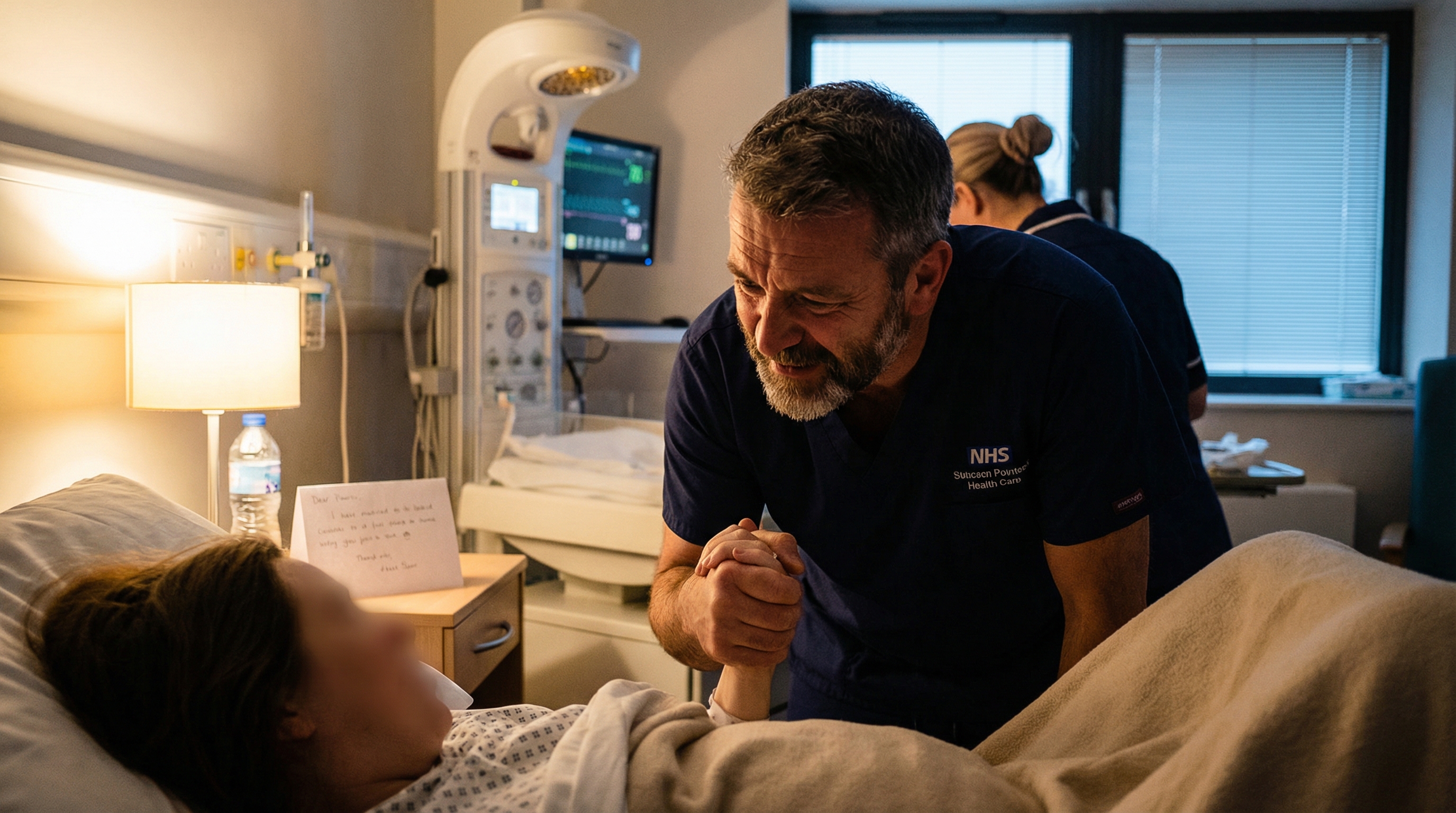
This isn't a sanitised NHS leaflet. This is what the delivery room actually feels like when you're the one standing there in scrubs wondering what the hell you're supposed to do with your hands.
What the Delivery Room Actually Looks Like
First things first - forget whatever you've seen on TV. There's no dramatic rush down a corridor with someone shouting "PUSH!" while orchestral music swells.
A delivery room (or birth suite, or labour ward - depending on your hospital) is surprisingly... ordinary. It's a private room, usually with:
- A hospital bed that adjusts to roughly 47 different positions
- A birthing ball (big gym ball)
- A wireless monitor for tracking baby's heartbeat
- A gas and air (Entonox) mouthpiece attached to a wall pipe
- A baby resuscitaire - a small table with a heat lamp where baby gets checked
- An en-suite bathroom (usually with a shower)
- A chair or recliner for you - your throne for the next however-many hours
Some rooms have birthing pools. Some have fairy lights and bluetooth speakers. Some feel more clinical. It depends entirely on the hospital and whether you're in a midwife-led unit or consultant-led ward.
The smell: Antiseptic meets warm humidity. It's not unpleasant, but it's unmistakably "hospital."
The lighting: Usually adjustable. Midwives know that dim lighting helps labour progress, so expect mood lighting rather than surgical brightness - at least until the business end.
The temperature: Warm. Uncomfortably warm, sometimes. They keep it heated for baby's arrival. Pack a light t-shirt. You will sweat.
Your Role as Birth Partner: What You're Actually There to Do
Here's the truth nobody tells you in antenatal class: your job in the delivery room isn't complicated. But it is crucial.
You are there to be her anchor. That's it. Everything else flows from that. For a full breakdown of what a birth partner actually does at each stage, we've got a dedicated guide.
The Practical Tasks
During early labour:
- Time contractions (there are free apps - use one)
- Keep her hydrated - small sips of water between contractions
- Offer snacks (she might not want them, but have them ready)
- Manage the music/lighting/temperature
- Rub her lower back during contractions if she wants (and stop immediately if she doesn't)
- Be the point of contact for family - she shouldn't be answering texts
During active labour:
- Hold her hand, leg, arm, hair - whatever she needs
- Remind her to breathe (this sounds patronising until you see someone forget)
- Pass her the gas and air mouthpiece
- Wipe her face with a cool flannel
- Talk her through each contraction: "You're doing amazing. That one's nearly done. Breathe."
- Advocate for her with medical staff if she can't speak for herself
- Keep track of what's been discussed - she may not remember
The big ones people forget:
- Keep your phone charged (you'll need it for photos after, and potentially for emergency calls)
- Bring a long charging cable
- Eat when you can - you're no use to anyone if you faint from low blood sugar
- Wear comfortable shoes - you may be standing for 12+ hours
What NOT to Do
- Don't say "I know how you feel." You don't.
- Don't complain about being tired. Absolutely not.
- Don't sit in the corner scrolling your phone
- Don't invite anyone to the hospital without asking her first
- Don't panic. Even if you're panicking, don't show it.
The Emotional Reality (The Bit Nobody Warns You About)
Every dad describes the delivery room differently, but there's a pattern: terrifying and incredible, simultaneously.
You will feel helpless. Properly, gut-wrenchingly helpless. The person you love most is in pain, and you can't fix it. You can't take it away. You can only be there. And for someone who likes to solve problems, that's excruciating.
You might cry. Loads of dads cry. During labour, after birth, in the car park three hours later when you're calling your mum. It's fine. It's normal. It's healthy.
You might feel sick. The sights and smells can be intense - blood, bodily fluids, things you didn't expect. If you feel light-headed, sit down. Nobody will judge you. The midwives have seen it a thousand times.
You might feel disconnected. Some dads describe feeling like an observer rather than a participant. Like watching it happen to someone else. That's also normal - it's your brain processing something overwhelming.
The important thing: however you feel, you can process it later. Right now, she needs you present. Not perfect. Just there.
When the Birth Plan Goes Out the Window
You spent three evenings writing a birth plan on nice paper. You discussed aromatherapy oils and hypnobirthing playlists. You printed two copies.
And now the midwife is explaining that things need to change.
This happens. A lot. Birth plans are brilliant for thinking through preferences, but labour is unpredictable. Here's how things might shift:
- She wanted a water birth → pool's occupied / baby's heart rate needs continuous monitoring
- She wanted no pain relief → 16 hours in, she's asking for an epidural
- She wanted delayed cord clamping → baby needs immediate attention
- She wanted a vaginal birth → it's becoming a C-section
Your job when the plan changes: be calm, ask questions, support her decision. Don't argue with medical staff unless something feels genuinely wrong. Don't make her feel guilty for changing her mind. She's not failing. She's doing what's needed.
Ask the midwife: "Can you explain what's happening and why?" That's your right. That's your job.
Want the complete guide?
From pregnancy to age two - the evidence-based, dad-tested playbook you actually need.
Get The New Dad Playbook - £29The Moment of Birth
Nothing prepares you for it. Nothing.
One moment you're in the middle of chaos - encouragement, medical instructions, noise, effort - and then suddenly, there's a person. A brand new person who didn't exist in the world thirty seconds ago. And they're covered in vernix and blood and they're screaming and they're yours.
What you might see:
- The head emerging first (if vaginal birth)
- Lots of blood and fluid - this is normal
- The baby might look blue/purple initially - also normal
- They may cry immediately or take a moment
- The midwife will quickly assess and may place baby directly on mum's chest
What you'll feel: Honestly? It varies wildly. Some dads feel an instant surge of love. Others feel shock. Others feel relief. Some feel numb. All of these are valid. Don't worry if you don't feel an instant "movie moment" connection - for many dads, that bond builds over days and weeks.
Cord Cutting
If you want to cut the cord, tell your midwife beforehand. It's completely optional - nobody will judge you either way.
What it's actually like: tougher than you'd expect. It's not like cutting string. It's more like cutting through a thick rubber tube. The midwife will clamp it first and show you where to cut. It doesn't hurt the baby or mum.
The Golden Hour
The first hour after birth is called the golden hour. Baby goes skin-to-skin on mum's chest (or on your chest if mum can't). The room gets quiet. The medical checks happen gently in the background.
This is the moment you take a breath. You look at this tiny person. You look at her. You realise what just happened.
Take a photo. Have a cry. Tell her she's incredible (because she is).
C-Section: What Happens If It Goes Surgical
Roughly 25-30% of births in the UK are by caesarean section. If this happens, here's what to expect:
Planned C-section:
- You'll both know in advance
- You'll be given scrubs, hat, and shoe covers
- You sit by her head, behind a screen (you can't see the surgery)
- The anaesthetist is your new best friend - they're right there too
- It takes about 10-15 minutes to deliver baby, then 30-45 minutes to stitch up
Emergency C-section:
- Things move fast. Really fast.
- You might be asked to wait outside briefly while they set up
- Stay calm. The team does this every day.
- You'll be brought in for the birth itself
Your role during a C-section:
- Stay by her head
- Talk to her - she's awake but can't feel below the chest
- She might shake/shiver - this is normal (it's the anaesthetic)
- When baby is lifted over the screen, that's your moment
- You'll likely get skin-to-skin first while she's being stitched
What Happens After the Birth
The bit nobody talks about: the hour after the golden hour.
- Mum: Gets stitched if needed (tears are common - ask the midwife about grades if you want to understand). Gets checked. May shower. Will be exhausted.
- Baby: Gets weighed, measured, and has a quick check (APGAR score at 1 and 5 minutes). Gets a tiny hat and possibly a nappy.
- You: Make the phone calls. Send the texts. Take more photos. Help her get comfortable.
You'll then either stay on the postnatal ward (where visiting hours may be restricted - check your hospital's policy) or, if everything's straightforward and it's a midwife-led unit, you might go home within 6-12 hours.
Pack snacks for the postnatal ward. The toast and tea after delivery is legendary - but after that, hospital food is... hospital food. Bring her favourites.
How to Actually Prepare
- Do a hospital bag for YOU - change of clothes, toothbrush, snacks, phone charger, coins for parking
- Know the route - drive it at different times of day. Know where to park. Know where the entrance is at 3am
- Understand pain relief options - gas and air, pethidine, epidural, water, TENS machine. Know what she wants, and know they're all valid choices
- Tour the unit if your hospital offers it
- Read the birth plan together - know it well enough to advocate for her when she can't speak
- Discuss the "what ifs" - what if it's a C-section? What if she changes her mind on pain relief? Having these conversations beforehand removes pressure in the moment
Frequently Asked Questions
Can dads stay overnight in the delivery room?
Most hospitals allow birth partners to stay throughout labour and delivery. However, on the postnatal ward, visiting hours vary by hospital. Some NHS trusts now allow partners to stay 24/7, while others have restricted hours. Call your hospital's maternity unit or check their website for their specific policy - this is one of the most important things to find out before the due date.
What should I wear to the delivery room?
Comfortable, layered clothing. The room is often warm, so a t-shirt you don't mind getting messy is ideal. Wear trainers or comfortable shoes - you may be on your feet for many hours. Avoid anything you'd be upset about getting blood or fluids on. Some hospitals provide scrubs for C-sections.
What if I feel faint or sick during the birth?
This is far more common than anyone admits. If you feel light-headed, sit down immediately - on the floor if necessary. Put your head between your knees. The midwives are prepared for this and won't judge you. It doesn't make you a bad birth partner. Eating regularly, staying hydrated, and avoiding locking your knees while standing all help prevent it.
How long does labour usually last?
For a first baby, active labour (from 4cm dilated) averages 8-12 hours, but it can be much shorter or much longer. Early labour (before active labour) can last days. The pushing stage typically lasts 30 minutes to 2 hours for first-time mums. Every birth is different, and "average" means very little when it's happening to you. Read our guide on dad's role during labour to know exactly what you should be doing at each stage.
Am I allowed to take photos or videos during the birth?
Most hospitals allow photos after the birth and during the golden hour. Some allow photos during labour if the mother consents. Video during the actual delivery is typically discouraged by medical staff, though policies vary. Always ask your midwife, and always prioritise being present over getting the perfect shot. The best photo you'll ever take is the one right after - mum holding baby for the first time.
What if the birth doesn't go to plan?
Birth rarely follows the plan exactly - and that's okay. Your role is to support whatever decisions need to be made in the moment. If medical intervention is suggested, ask: "What's happening? Why is this recommended? What are the alternatives?" Then support her choice. She hasn't failed if the birth looks different from what you both imagined. A safe mum and baby is always the plan.
The delivery room is one of those rare life moments where everything changes in a single day. You'll walk in as a couple and walk out as a family. It's messy, intense, boring, terrifying, and beautiful - often all within the same hour. You don't need to be perfect. You just need to show up.