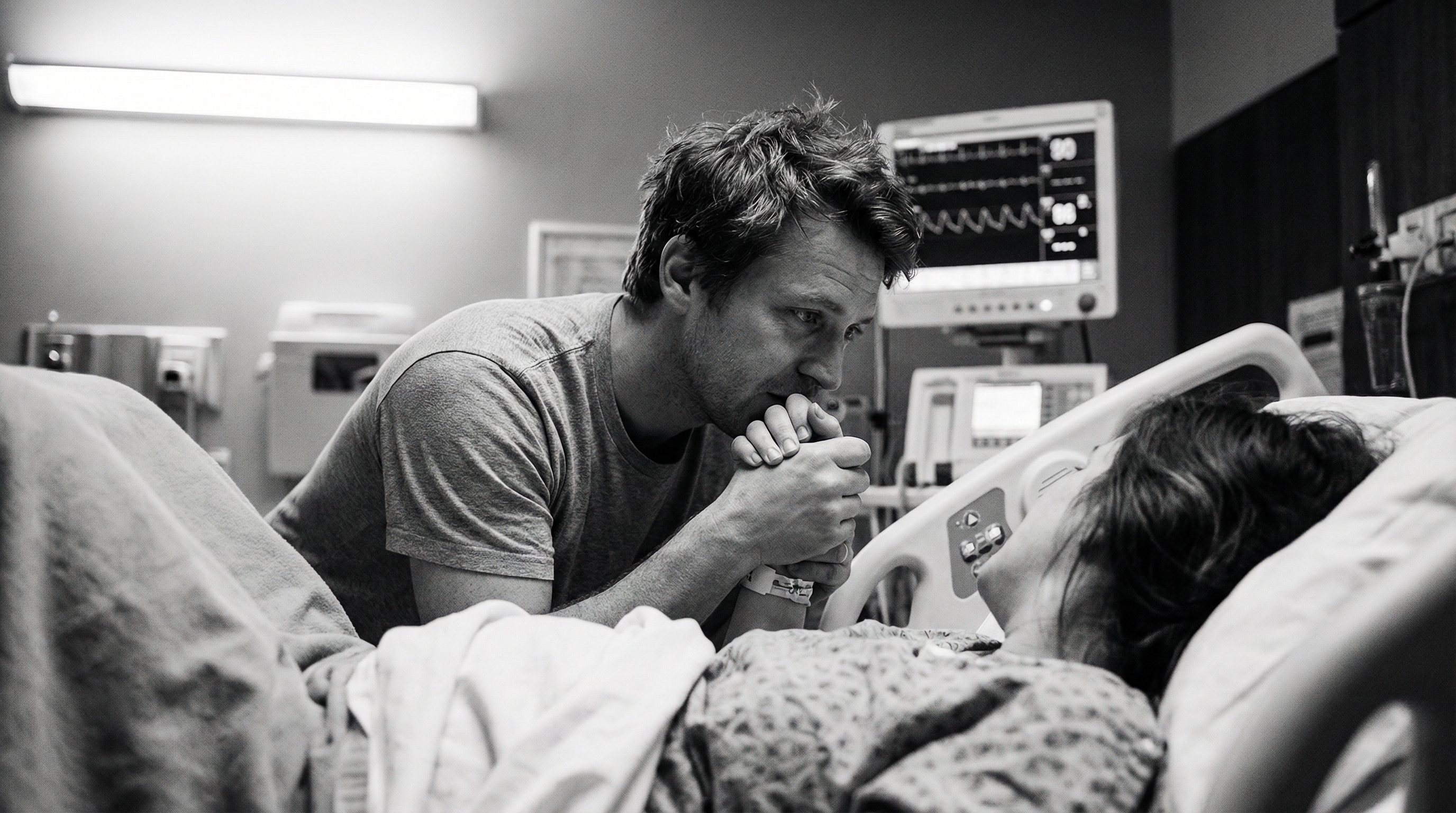


Let's get the uncomfortable truth out of the way first: most dads feel completely useless during labour. You've spent nine months preparing, reading books, attending antenatal classes, practising breathing exercises - and then when it actually starts, you're standing in a delivery room thinking, “What the hell am I supposed to do?”
You're not alone. Every dad feels this. The midwives have seen it a thousand times. And here's the thing nobody tells you: you don't need to be a hero. You don't need to “fix” anything. You just need to be present, calm, and useful in small but important ways.
This is the hour-by-hour guide to what you can actually do during labour. Not the NCT version. Not the Hollywood version. The real one.
The Honest Truth About How Dads Feel in Labour
Before we get into the practical stuff, let's acknowledge something. You're going to feel a combination of:
- Helpless - she's in pain and you can't take it away
- Scared - what if something goes wrong?
- Useless - the midwives know what they're doing, so what's your role?
- Exhausted - labour can last 12, 24, even 36 hours
- Overwhelmed - there's blood, there's noise, there are machines beeping
All of this is normal. None of it makes you weak. The dads who struggle most are the ones who expected to feel heroic and confident. The dads who do well are the ones who accepted they'd feel scared - and showed up anyway.
Your job isn't to deliver the baby. Your job is to be her anchor. For a complete breakdown of every responsibility, read our guide on what a birth partner actually does.
Early Labour: What to Do at Home
Early labour is the long, slow part. Contractions start but they're irregular - maybe every 15-20 minutes, lasting 30-45 seconds. This phase can last hours. Sometimes a full day.
What to do:
- Time the contractions. Use the Freya app (free from the NHS) or just your phone timer. Note how far apart they are and how long each one lasts. The hospital will ask.
- Don't rush to hospital. The general rule in the UK is 4-1-1: contractions every 4 minutes, lasting 1 minute, for at least 1 hour. Going too early means you'll likely be sent home.
- Keep her comfortable. Run a bath. Put on a film. Make her toast. This sounds boring because it is - that's the point.
- Eat properly yourself. This is not selfishness. You're about to run a marathon and you need fuel. Eat a proper meal now, because once you're at the hospital, it's vending machine territory.
- Pack the car. Hospital bags loaded, car seat fitted, phone chargers packed. Parking change if needed (though most NHS hospitals have pay-by-app now).
- Stay calm. Your anxiety is contagious. If you're pacing and panicking, she'll feel it. Watch telly. Have a cup of tea. Be boringly calm.
One practical tip that nobody mentions: put a towel or bin bag on the car seat. Waters can break at any time, and you don't want to be cleaning amniotic fluid off your Vauxhall Corsa at 4am.
Active Labour: The 3 Things That Actually Help
Active labour is when things get serious. Contractions are every 3-5 minutes, lasting 45-60 seconds, and she can't talk through them anymore. You're probably at the hospital or birth centre by now.
Here's what actually helps - distilled from hundreds of dads:
1. Physical Support
- Counter-pressure on her lower back. During contractions, press the heel of your hand firmly into her lower back, just above the tailbone. Ask her where. She'll tell you (probably not politely).
- Hold her hand. Simple. Effective. Let her squeeze as hard as she needs to.
- Help her move. Walking, swaying, leaning over the bed, sitting on a birth ball. Movement helps the baby descend. You're her support rail.
- Cool flannel on her forehead. Wring it out, fold it, place it gently. Repeat every few minutes.
2. Verbal Support
- Short, calm phrases. "You're doing brilliantly." "One at a time." "That one's done." Don't give speeches. Don't ask questions during contractions.
- Match her energy. If she's quiet, be quiet. If she wants to talk between contractions, talk. If she tells you to shut up, shut up. It's not personal.
- Remind her to breathe. Slow breathing out is the most effective pain management technique there is. Breathe with her if it helps. In through the nose, long slow breath out through the mouth.
3. Practical Support
- Be her advocate. If she has a birth plan, know it. If she wants to try without an epidural first, communicate that to the midwife. If she changes her mind (she might - that's fine), support that too.
- Offer water between contractions. A sports bottle with a straw is ideal - she can sip without sitting up.
- Keep the room right. Dim lights if she wants them. Music on if she wants it. Ask the midwife before opening curtains or turning on the big light.
Here's the secret: you don't need to do anything dramatic. Just being calm, present, and responsive to what she needs in each moment - that's the job.
Transition Phase: Staying Calm When It Gets Intense
Transition is the phase between active labour and pushing. It's usually the shortest phase (30 minutes to 2 hours) but it's the most intense. Contractions are almost continuous. She might vomit, shake, cry, or say she can't do this anymore.
What you need to know:
- "I can't do this" usually means she's nearly there. This is one of the most important things to understand. When she says she can't go on, it often means she's in transition and the pushing stage is close. Tell her: "You're so close. You're doing this."
- Don't take anything personally. She might swear at you. She might tell you she hates you. She might push your hand away and then grab it back 30 seconds later. This is normal. This is not about you.
- Stay anchored. Your calm is her calm. Even if you're terrified inside, keep your voice steady, your breathing slow, your body relaxed. She's reading you like a book.
- Don't leave the room. Unless she explicitly asks you to, or you genuinely need the loo (be quick), stay. This is not the time to check your phone or pop out for a coffee.
If she's had an epidural, transition might be less dramatic. She might be calm, chatting, watching telly. That's fine too. Every labour is different.
The Pushing Stage: Positioning and Encouragement
The midwife will guide most of this, but here's where you can help:
- Support her position. If she's upright, hold her from behind. If she's on her side, hold her leg. If she's on all fours, just be there with a hand on her back.
- Count with her if the midwife asks. Sometimes they'll ask you to count to ten while she pushes. Keep your voice calm and steady.
- Don't coach unless asked. The midwife is the expert. Your job is emotional support, not instruction. If you start saying "push harder" without being asked, you will not be popular.
- Breathe. Seriously. Dads forget to breathe during pushing. You might feel lightheaded. Sit down if you need to - nobody will judge you.
The pushing stage can last from a few minutes to a couple of hours for a first baby. It's intense. It's loud. It's messy. And it ends with the most extraordinary moment of your life.
Cord Cutting: Do You Have To?
Short answer: no.
The midwife will usually ask if you want to cut the cord. Some dads desperately want to. Some would rather not. Both are completely fine.
If you do want to cut it:
- It's tougher than you expect - more like cutting through a thick rubber hose
- The midwife will clamp it in two places and you cut between the clamps
- You can't hurt the baby or mum - there are no nerve endings in the cord
If you don't want to:
- Just say "no thanks, you go ahead" to the midwife
- Nobody will think less of you
- Your partner probably won't even notice - she's busy meeting your baby
Some couples opt for delayed cord clamping (waiting a few minutes before cutting) as there's evidence it benefits the baby's iron stores. Your midwife will usually suggest this as standard practice in the UK now.
The First Moments
The baby is here. They'll probably be placed straight onto mum's chest for skin-to-skin. You might cry. You might not. You might just stare in disbelief. All responses are valid.
What to do:
- Take a photo. Just one or two. This moment is gone in seconds. You don't need a photoshoot, but you'll want something.
- Tell her she was amazing. Because she was.
- Look at your baby. Really look. Count the fingers if you want to. Touch their head. Say hello.
- Don't panic about the afterbirth. The placenta still needs to be delivered. The midwife handles this. It's anticlimactic but necessary.
- Ask if you can do skin-to-skin too. If mum needs stitches or is being tended to, ask if you can hold the baby against your chest. Unbutton your shirt. This is bonding. It matters.
What If It's an Emergency?
Sometimes things don't go to plan. Assisted delivery (ventouse or forceps), emergency C-section, or complications that mean everything gets very medical, very fast.
Your role in an emergency:
- Stay out of the way of medical staff. Move when asked. Stand where they tell you.
- Stay calm. This is the hardest one. But the team does this every day. They are trained for this. Trust them.
- Hold her hand. Even in theatre, you can usually sit by her head during a C-section. Hold her hand. Talk to her. Be her world while the surgeons do theirs.
- Ask questions later. In the moment, let the team work. Write down your questions afterwards - the midwife or doctor will debrief with you.
If she needs a general anaesthetic (rare), you might be asked to leave. This is terrifying. Go to the waiting area. Someone will come and get you. Your baby will be fine. She will be fine. Breathe.
The 2 Hours After Birth
The “golden hours.” In the UK, you'll usually stay in the delivery room for at least an hour or two after birth while the midwife does checks. For what comes after you go home, our guide to supporting your partner after birth picks up where this one ends.
What to do:
- Help with the first feed. If she's breastfeeding, the midwife will help with positioning. Your job: pillows, water, encouragement. Don't worry if it doesn't work perfectly first time - it takes practice.
- Make the phone calls. Text the grandparents. Send that first photo. Let people know everyone's okay.
- Eat something. You've earned it. That cereal bar in your hospital bag is calling.
- Take it in. You're a dad. That tiny, scrunchy, screaming human is yours. It hasn't sunk in yet. That's okay. It might not sink in for days. Or weeks. Or until the first time they fall asleep on your chest and you realise you'd burn the world down to keep them safe.
Going Home
If everything went well and it was a vaginal delivery, you might go home the same day or the next morning. C-sections usually mean 1-3 days in hospital.
Before you leave:
- Car seat ready. You'll need to show the midwife it's properly installed before they'll let you leave. Practice fitting it before the due date.
- Have her comfortable clothes ready. She'll want loose, soft clothing. Think maternity leggings, not jeans.
- Drive like you're carrying a bomb. Every speed bump will feel like a personal attack. Take it slow.
- When you get home, let her rest. Make tea. Order food. Handle visitors. Your job for the next 48 hours is to protect her peace.
Frequently Asked Questions
Can dads stay overnight on the postnatal ward?
In most NHS hospitals, partners cannot stay overnight on the postnatal ward due to space and privacy restrictions for other patients. However, policies vary - some hospitals have private rooms where partners can stay, and many relaxed their rules post-COVID. Check with your specific hospital well before the due date.
What should dads pack in their hospital bag?
Pack snacks (lots of them), a phone charger (long cable), a change of clothes, toothbrush, deodorant, coins or a card for parking, and a pillow if there's room. You'll want comfortable shoes - you might be standing for hours. A book or downloaded shows for early labour waiting is smart too.
How long does labour actually last for first-time parents?
First labours average 12-18 hours from established labour to delivery, though it varies hugely. Early labour (before things get intense) can add another 6-12 hours on top. Some first babies arrive in 4 hours; others take over 24. There's no reliable way to predict it.
What if I feel faint or sick during the birth?
It's more common than you think. Sit down immediately - on a chair, on the floor, wherever. Put your head between your knees. The midwives are prepared for this and won't judge you. Eat and drink regularly throughout labour to prevent it. If you need to step out briefly, tell the midwife.
Should dads attend all the antenatal appointments?
You don't need to attend every routine midwife appointment, but try to be at the dating scan (around 12 weeks), the anomaly scan (around 20 weeks), and any appointments where decisions are being made. If your employer doesn't give you time off for these, most dads use annual leave or flexible working. Your presence matters more than you think.
What is a birth partner's role during a C-section?
During a planned or emergency C-section, you'll usually sit by her head on the other side of the screen. Hold her hand, talk to her, keep her calm. You might be able to watch the baby being lifted out if you want to - but you don't have to look over the screen. When the baby is checked and wrapped, you'll often be the first to hold them while she's being stitched up. It's a beautiful moment.
Want the complete guide?
Everything from pregnancy to age two. Evidence-based, dad-tested, no fluff.
Get The New Dad Playbook - £29