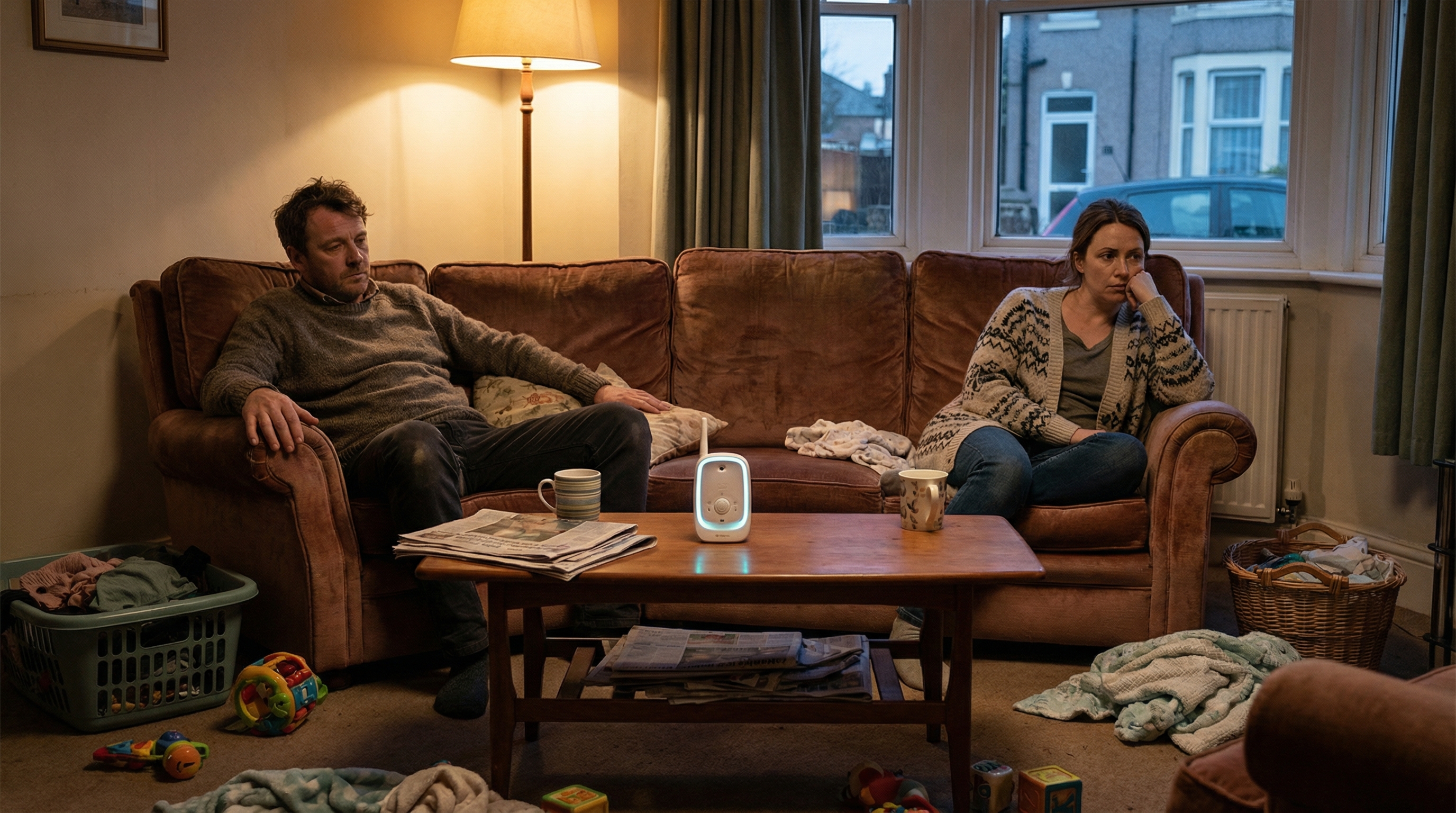


You adore your baby. You'd do anything for them. But somewhere between the 3am feeds and the arguments about whose turn it is to change a nappy, you've started wondering: what the hell happened to us?
If that sounds familiar, take a breath. You're not broken. Your relationship isn't doomed. What you're going through is so common that researchers have studied it exhaustively - and the numbers are staggering.
According to relationship researcher John Gottman, 67% of couples experience a significant decline in relationship satisfaction within the first three years of their child's life. Two-thirds. That's not a minority of struggling couples - that's most of us.
So if you're sitting there feeling guilty because you snapped at your partner over something trivial, or because you can't remember the last time you had a proper conversation that wasn't about the baby, know this: you're in the majority. The question isn't whether your relationship will be tested. It's how you respond when it is.
Why Relationships Suffer After a Baby
Let's be honest about what's actually happening. A baby doesn't just change your schedule - it detonates your entire way of life. Everything you relied on for connection, intimacy, and individual identity gets scrambled overnight.
Here's what's really going on:
Sleep deprivation destroys your ability to cope. This isn't about being a bit tired. Chronic sleep deprivation - the kind you experience with a newborn - impairs your emotional regulation, decision-making, and empathy. You're literally operating with a compromised brain. Of course you're going to say things you don't mean.
Your time together evaporates. Before the baby, you had evenings, weekends, spontaneous moments. Now every waking minute is consumed by feeding, changing, soothing, cleaning, and trying to remember whether you've eaten today. The relationship gets whatever scraps are left - which is usually nothing.
Identity shifts hit hard. You're no longer just partners - you're parents. That's a seismic shift in how you see yourselves and each other. Mum may feel she's lost herself entirely. Dad may feel sidelined or useless. Both of you are grieving a version of your life that's gone, even while loving what's replaced it.
Hormones are real. For mums, the postnatal hormonal rollercoaster is intense - oestrogen and progesterone crash, prolactin surges, and the emotional impact is enormous. But dads experience hormonal changes too. Testosterone typically drops in new fathers, which can affect mood, energy, and libido.
The Specific Triggers Nobody Warns You About
The Division of Labour War
This is the big one. Research consistently shows that the division of household and childcare labour is the number one source of conflict for new parents.
Here's what typically happens: before the baby, things were roughly equal (or at least felt that way). After the baby, especially if mum is on maternity leave and dad goes back to work, the split becomes dramatically uneven. Mum handles the vast majority of childcare and housework. Dad comes home thinking he's done his bit by earning money. Mum is furious because she's been "on" for 14 hours straight with no break.
Neither person is wrong. Both are exhausted. But the resentment builds silently.
What actually helps: Have an explicit conversation about who does what. Not a vague "I'll help more" - an actual list. Who does night feeds? Who cooks? Who does the mental load (remembering appointments, tracking nappy supplies, booking health visitor visits)? Write it down. Revisit it weekly.
Exhaustion Makes Everything Worse
When you're running on four hours of broken sleep, you don't have the emotional bandwidth for nuance. Small irritations become massive grievances. A forgotten task becomes evidence of not caring. A tired sigh gets interpreted as contempt.
This isn't a character flaw - it's neuroscience. Your prefrontal cortex (the rational, empathetic part of your brain) literally goes offline when you're sleep-deprived. You're running on your amygdala, which deals in fight-or-flight, not compromise and understanding. This is why anger after becoming a dad is one of the most common - and least talked about - experiences of new fatherhood.
What actually helps: Name it. "I'm so tired I can't think straight, and I know I'm being unreasonable." That one sentence can defuse more arguments than any clever communication technique.
Emotional Distance
You might find yourselves becoming co-managers of a tiny human rather than romantic partners. Conversations shrink to logistics: "We need more wipes." "Health visitor's on Thursday." "Your mum's coming at two."
The emotional connection - the bit that made you fall in love - gets buried under admin. And because you're both so depleted, neither of you has the energy to dig it out.
Parenting Style Clashes
You want to let the baby self-settle. Your partner wants to pick them up immediately. You think screen time at six months is fine. Your partner thinks it's toxic. These disagreements feel enormous when you're exhausted, because they tap into deep beliefs about what kind of parent you are.
The Resentment Trap
Resentment is the silent killer of relationships after a baby. It builds slowly, almost invisibly, until one day you realise you're keeping score of every unequal moment.
I got up three times last night and she only got up once.
He gets to leave the house for work while I'm trapped here.
She never acknowledges how hard I'm working to provide for us.
He comes home and sits on his phone while I'm drowning.
The problem with resentment is that it rewrites history. Once you start resenting your partner, you stop giving them the benefit of the doubt. Everything they do gets filtered through the resentment lens. A genuine attempt to help becomes "too little, too late." A moment of tiredness becomes "not pulling their weight."
Breaking the cycle: The antidote to resentment is expressing needs before they become grievances. "I need you to take the baby for an hour on Saturday so I can have a break" is a request. Waiting until you're furious and saying "You NEVER give me any time to myself" is an accusation. Same need. Completely different impact.
Want the complete guide?
Everything from pregnancy to age two. Evidence-based, dad-tested, no fluff.
Get The New Dad Playbook - £29Communication That Actually Works When You're Exhausted
Forget the textbook advice about "active listening" and "I-statements." When you've had three hours of sleep, you need communication strategies that work for zombie-level humans.
The 10-Minute Check-In
Every evening, after the baby's down, sit together for ten minutes. Not to solve problems - just to check in. "How are you, really?" "What was the hardest part of today?" "What do you need from me tomorrow?"
Ten minutes. That's it. No phones. No TV. Just two knackered people reminding each other they're on the same team.
The Repair Attempt
Gottman's research shows that successful couples aren't the ones who never fight - they're the ones who repair after conflict. A repair attempt is anything that de-escalates tension: humour, an apology, a touch, a change of subject, acknowledging you're being a prat.
"I know I'm being snappy. I'm sorry. I don't mean it." That's a repair attempt. It costs nothing and it works.
The "Same Team" Reframe
When you catch yourself thinking of your partner as the enemy - which you will, because exhaustion does that - consciously reframe. You're not against each other. You're two people in a trench together, getting shelled, trying to keep a tiny human alive. The enemy is the situation, not each other.
Sex and Intimacy After Birth: Realistic Expectations
Let's talk about the elephant in the bedroom.
For many couples, sex disappears after a baby - and this is completely normal. The NHS recommends waiting until after the six-week postnatal check, but the reality is that many couples take much longer than that, and that's fine.
For mums: The physical recovery from birth is significant, whether vaginal or caesarean. Add breastfeeding (which suppresses libido through hormonal changes), exhaustion, feeling "touched out" from having a baby on you all day, and possible body image issues. Sex may be the last thing on her mind.
For dads: You might be desperate for physical connection - not just sex, but any kind of intimacy. Or you might be so exhausted that your libido has tanked too. Both are normal.
What helps:
- Don't keep score. "It's been X weeks" is not helpful.
- Start with non-sexual touch. Holding hands. A hug that lasts more than two seconds. Physical affection that doesn't have an agenda.
- Talk about it. Not in a pressuring way - in an honest, vulnerable way. "I miss being close to you" hits differently than "When are we going to have sex again?"
- Accept the new timeline. Some couples resume intimacy after weeks. Others take months. There's no "should" here.
The Primary vs Secondary Carer Dynamic
If one of you is the primary carer (usually mum in the early months, especially if breastfeeding), a power dynamic can emerge that's toxic if left unaddressed.
The primary carer becomes the "expert" - they know the baby's cries, routines, and preferences. The secondary carer feels incompetent, unwelcome, or criticised every time they try to help. So they step back. Which makes the primary carer do even more. Which breeds more resentment. It's a vicious cycle.
Breaking it: The primary carer needs to let go of gatekeeping - even when it's hard. Let your partner do it their way, even if it's not your way. The secondary carer needs to step up without being asked, and push through the discomfort of not knowing what they're doing.
Your baby won't be damaged by being held differently or having their nappy put on slightly wonky. But your relationship will be damaged by one person being the expert and the other being the assistant.
When to Consider Professional Help
There's no shame in getting help. In fact, it's one of the smartest things you can do. Consider couples therapy or counselling if:
- You're arguing constantly and can't break the cycle
- One or both of you feels persistently unhappy, hopeless, or detached
- Resentment has hardened into contempt (eye-rolling, mockery, disgust)
- You've stopped communicating meaningfully
- There's been infidelity or a significant breach of trust
- One partner may be experiencing postnatal depression or anxiety
UK Resources
- Relate - The UK's largest provider of relationship support. Offers face-to-face, phone, and online counselling. Fees are on a sliding scale.
- NHS Talking Therapies - Free, self-referral, available across England for anxiety and depression (including postnatal).
- Family Lives - Free helpline and online support for family relationship issues.
- Dad Matters - Specifically for dads' mental health and relationship support.
What the Research Says About Recovery
Here's the hopeful part. That same Gottman research that tells us 67% of couples experience a decline also shows that the couples who navigate it well come out stronger. The shared experience of raising a child - the sleepless nights, the first smile, the terrifying A&E visit, the moment they say "Dada" - creates a bond that's deeper than what came before.
The couples who thrive tend to share five things:
- They talk about what's hard - honestly, without blame
- They share the load - not perfectly, but intentionally
- They maintain physical affection - even when sex isn't happening
- They protect small moments of connection - a cup of tea together, a text during the day
- They ask for help - from each other, from family, from professionals
Your relationship will change after a baby. That's inevitable. But "change" doesn't have to mean "decline." It can mean deeper, messier, more real, and ultimately stronger - if you're both willing to put in the work.
Frequently Asked Questions
Is it normal to resent your partner after having a baby?
Yes, completely. Resentment after a baby is one of the most common relationship experiences, driven by exhaustion, unequal division of labour, and unmet expectations. The key is to address it early through honest conversation rather than letting it build. Express your needs as requests, not accusations, and try to view your partner as a teammate rather than an adversary.
How long do relationship problems last after having a baby?
Research suggests that relationship satisfaction typically dips in the first year and can take 2-3 years to recover. However, this varies enormously between couples. Those who communicate openly, share responsibilities, and seek help when needed tend to recover faster. Some couples find their relationship genuinely improves as they settle into parenthood together.
How can dads help when mum is struggling after birth?
Take initiative without being asked - don't wait for instructions. Handle household tasks, manage visitors, protect her rest, and take the baby for stretches so she can shower, sleep, or just exist without being needed. For specific strategies, see our guide on how to support your partner after birth. Listen without trying to fix. Acknowledge that her experience of early parenthood is physically and emotionally harder than yours. And if she shows signs of postnatal depression, gently encourage her to speak to her GP or health visitor.
Should we go to couples therapy after having a baby?
If you're struggling, absolutely. There's no threshold of "bad enough" that you need to reach first. Couples therapy is most effective when accessed early, before resentment hardens into contempt. In the UK, Relate offers affordable counselling, and NHS Talking Therapies provides free support for anxiety and depression. Think of it as maintenance, not a last resort.
How do you keep your relationship strong after a baby?
Prioritise small, consistent connection over grand gestures. A nightly ten-minute check-in, regular physical affection (not just sex), explicit division of responsibilities, and genuine appreciation for each other's efforts. Protect your identity as a couple - not just as parents. Accept that your relationship will look different, and focus on building something new rather than mourning what's changed.
When should we be worried about our relationship after a baby?
Seek help if you notice persistent contempt (mockery, eye-rolling, disgust), emotional withdrawal from either partner, constant unresolved conflict, or feelings of hopelessness about the relationship. Also watch for signs of postnatal depression in either parent, as this significantly impacts relationship functioning. If in doubt, speak to your GP or contact Relate for an initial assessment.